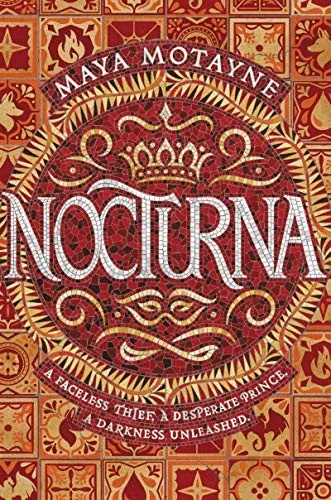
Nocturna
Maya Motayne
Author Reading Guide
Maya Motayne is a New York author of Latinx-inspired young adult fantasy, best known for the Forgery of Magic trilogy that began with her 2019 debut Nocturna.
Maya Motayne
Maya Motayne decided she was going to be a writer at four years old and has not revised the plan since. She lives in New York City, where by her own account she spends her time petting as many dogs as possible and evaluating handbags exclusively on whether they can hold a large hardcover. Nocturna, her debut, arrived in 2019 and established her as one of the more distinctive voices in the wave of young adult fantasy built on non-European settings that reshaped the category in the late 2010s.
The Forgery of Magic trilogy is set in San Cristóbal, a city and kingdom drawn from Dominican culture and history, and the setting is doing real work rather than providing decoration. Language, food, class structure and colonial memory are all threaded through the worldbuilding. The two leads are Finn Voy, a face-changing thief who can wear anyone's appearance and has lost track of her own, and Alfehr, a prince who has been living under the weight of his brother's disappearance and is not managing it well. They meet badly, they accidentally release something ancient and hungry, and the trilogy is the long consequence of that.
What defines Motayne's writing is character interiority under pressure. Both of her leads are running from a specific, concrete grief, and the magic system externalises it: Finn's shapeshifting is a metaphor for self-erasure that the plot takes seriously rather than treating as a superpower. Alfie's magic is bound up with a brother he cannot stop looking for. The prose is quick and dialogue-heavy, and the humour is sharper than the premise suggests. Where the books occasionally strain is pacing in the middle volume, a common trilogy problem, but the ending sticks.
The three books are Nocturna in 2019, Oculta in 2021, and Lucero in 2023, and the series is complete. That last part matters for readers who have been burned by young adult fantasy trilogies that stall after book two. You can read the whole thing today.
On heat, set expectations correctly: this is young adult, and on our spice scale the trilogy sits at 0 to 1. The romance between Finn and Alfie is central and satisfying and it is built almost entirely out of tension, banter and shared damage. There are kisses. There is nothing on the page beyond that. Readers arriving from adult romantasy should treat this as a slow burn with a closed door rather than a lighter version of what they usually read.
Why she matters to a romantasy audience: the Finn and Alfie dynamic is a textbook example of enemies to lovers where the enmity is structural rather than performative. She is a thief, he is the crown, and neither of them can afford the other. A lot of the current genre uses that setup and resolves the structural problem too early. Motayne holds it. Beyond the romance, she belongs to the cohort of authors, alongside Tomi Adeyemi and Roshani Chokshi, who moved young adult fantasy away from a default European medieval setting, and that shift fed directly into the range of settings romantasy takes for granted now.
Where to start: Nocturna, obviously, and read all three in order because the trilogy is a single arc with a shared antagonist. If you finish and want the same Latin American-inflected fantasy at a higher heat level, the adult shelf has plenty of options and our book quiz will narrow them down in a couple of minutes. If instead you want more young adult fantasy with a thief protagonist and a completed series behind it, Leigh Bardugo's Six of Crows duology is the natural next stop, and it shares Nocturna's interest in crews of clever people who lie for a living. What Motayne does that Bardugo does not is keep the emotional cost of the lying in the foreground, which is why her books linger.