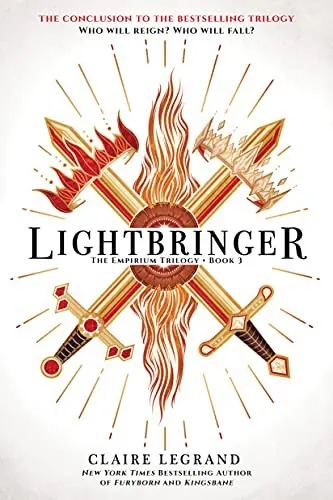
Lightbringer
Claire Legrand
Author Reading Guide
Claire Legrand is a New York Times bestselling author and librarian whose Empirium trilogy pairs epic fantasy with a dual-timeline structure across fourteen novels of work.
Claire Legrand is the rare fantasy author whose overnight success took twelve years. She got the idea for the Empirium trilogy shortly after high school, on a trip home, listening to music, with a vision of a young woman standing in a field of fire. She worked on the first draft of Furyborn throughout college and queried it without success, because the manuscript was too long and not ready. So she shelved it, wrote something else, and sold that instead. The Cavendish Home for Boys and Girls became her debut in 2012. Furyborn finally reached readers in May 2018 and debuted at number four on the New York Times bestseller list.
Born in 1986 and raised in Irving, Texas, Legrand holds a BA and an MSLS from the University of North Texas and works as both a writer and a librarian. She now lives in central New Jersey. The librarian half is not incidental. Her books are structurally ambitious in a way that suggests someone who has read very widely and thought hard about how stories are built. Furyborn runs two timelines a thousand years apart, alternating between Rielle in the past and Eliana in the future, and it withholds the connection between them long enough to make the eventual convergence land. Her prose is controlled, her violence is unflinching, and she writes women who are allowed to be genuinely unlikeable without the book apologising for it.
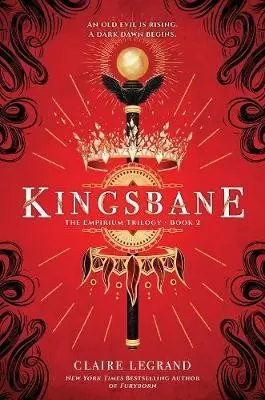
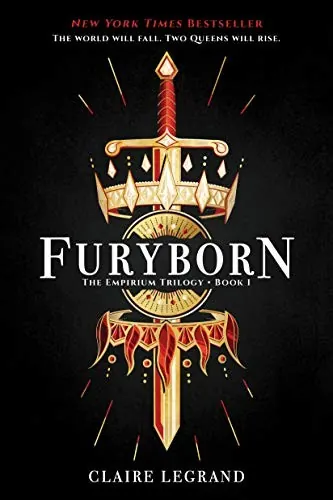
The Empirium trilogy is the main draw for this audience. Furyborn opens with a queen prophesied to save or destroy the world, undergoing seven trials to prove which she is. Kingsbane followed in May 2019 and also debuted at number four on the NYT list, then Lightbringer closed the trilogy in October 2020. Her range outside it is wide: the Middlemist trilogy, the horror-adjacent Sawkill Girls, and the contemporary Some Kind of Happiness. Across fourteen novels she has been a finalist for the 2017 Edgar Award, the 2018 Bram Stoker Award, and the 2019 Lambda Literary Award, which is an unusual spread for one writer and tells you she does not stay in one register.
Be clear-eyed about heat. On our spice scale the Empirium books land around a 2. There is sexual content, and Rielle's arc in particular involves desire as a corrupting force rather than a reward, but the books were published into the YA-to-adult crossover space and the explicit content is limited. Readers arriving from Fourth Wing expecting a similar ratio of romance to plot will find the balance tipped heavily toward plot. What you get instead is scale, moral complexity, and a genuine willingness to let the protagonists do unforgivable things.
Her value to a romantasy reader is as a corrective. The current shelf is dominated by romance-first fantasy where the world exists to complicate the relationship. Legrand writes the reverse: enormous stakes, a magic system with rules that cost something, and a romance that has to fit around a war rather than replace it. She is also a useful bridge for readers who want the emotional intensity of the chosen one structure without the wish fulfilment, because her chosen ones are catastrophic and the prophecy does not protect anyone.
Start with Furyborn and commit to at least the first two hundred pages. The dual timeline is disorienting early and the payoff is structural, so early impatience is common and usually misplaced. Read the trilogy in order; Kingsbane in particular depends entirely on what you learned in book one. If the Empirium books work for you, Sawkill Girls is the natural next stop for the darker, stranger side of her writing, and the Middlemist trilogy for a gentler one. If they do not, that is worth knowing quickly rather than slowly, and the rest of the catalogue is a browse away.