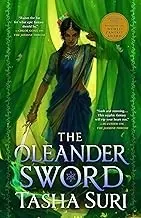
The Oleander Sword
Tasha Suri
Author Reading Guide
Tasha Suri is the World Fantasy Award winning British author of the Burning Kingdoms trilogy, an India-inspired epic that begins with The Jasmine Throne, plus the Books of Ambha duology.
Tasha Suri
Tasha Suri
Tasha Suri was a librarian in London before she was a novelist, and it shows in the deep grain of her books. She debuted in 2018 with Empire of Sand, the first of the Books of Ambha duology, a Mughal-India-inspired fantasy about magic, dance, and arranged marriage that earned immediate critical attention and a Best Newcomer nomination in genre circles. But it was The Jasmine Throne in 2021 that changed her career, opening the Burning Kingdoms trilogy and winning the World Fantasy Award, the kind of validation that turns a promising author into a defining one.
The trilogy is the spine of her reputation. The Jasmine Throne pairs Priya, a temple servant hiding deadly magic, with Malini, an imprisoned princess plotting her brother's downfall, and lets ambition and attraction curdle together. The Oleander Sword escalates the war and the romance in 2022, and The Lotus Empire closed the trilogy in November 2024 with an ending that asks whether Priya and Malini must destroy each other to save their kingdoms. Alongside the trilogy she published What Souls Are Made Of, a Wuthering Heights remix for the young adult shelf, and Doctor Who: The Cradle, a franchise novel that displays her range.
What defines Suri's writing is texture and consequence. Her worlds are built from South Asian history rather than the standard European toolkit: sacred rivers, empire and colonization, jasmine and oleander, faith that demands actual sacrifice. Her magic always costs something, usually the body. And her central romance is a masterclass in slow burn, two women on opposite sides of an empire who want each other and cannot afford to, written with patience most authors cannot sustain across three volumes.
On heat, be honest with yourself about what you are picking up. The Burning Kingdoms sits around a 1 to 2 on our spice scale: the desire between Priya and Malini is palpable on nearly every page, but on-page intimacy is restrained and brief, with the emphasis on power, devotion, and denial rather than explicit scenes. This is yearning as a load-bearing structure. Readers who need high heat should adjust expectations; readers who live for forbidden love with genuine political stakes will be exactly where they belong.
Suri matters to romantasy readers because she represents the genre's literary conscience. The sapphic romance at the heart of the Burning Kingdoms is not a subplot or a marketing angle; it drives the war, the theology, and the ending. She proved that an epic fantasy could put two women's desire at its center and win major awards doing it, and the wave of sapphic romantasy that followed owes her a visible debt. She writes empire the way the best epic fantasists do, and longing the way the best romance writers do.
Suri's background threads through everything she writes. Born in Britain to a Punjabi family, she has spoken often about writing the histories and mythologies she never saw in the fantasy she grew up loving, and about the years she spent as a librarian surrounded by other people's canons before building her own. That perspective gives her empires a lived-in specificity, food, fabric, ritual, and grief rendered with the same care as battle plans, and it is a large part of why her books feel translated from a real history rather than assembled from genre parts.
Start with The Jasmine Throne and read the trilogy in order; the payoff of The Lotus Empire depends on everything before it. The Books of Ambha duology stands separately and works beautifully as a follow-up, with Empire of Sand first. What Souls Are Made Of is the pick if you want her voice in a moodier, gothic young adult register. However you enter, give her prose a little room; the burn is slow because the fire is real.