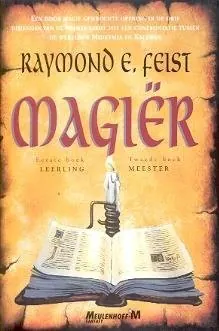
Magician: Master
Raymond E. Feist
Author Reading Guide
One of the founding figures of modern commercial epic fantasy, whose Riftwar Cycle began with Magician in 1982 and ran for more than thirty books across three decades.
Raymond E. Feist
Magician: Apprentice
Raymond E. Feist
Raymond E. Feist
Raymond E. Feist was born and raised in Southern California and graduated with honours in Communication Arts from the University of California, San Diego. The world he is famous for, Midkemia, did not begin as a novel. It began as a Dungeons and Dragons campaign setting invented by Feist and his college friends in the 1970s, played at a table, and only later written into fiction. That origin is not trivia. It is the reason the world feels lived in rather than designed, with towns that exist because someone once needed a place to buy rope.
Magician, published in 1982 and split in many editions into Magician: Apprentice and Magician: Master, follows two boys in the town of Crydee: Pug, an orphan apprenticed to a magician, and Tomas, a soldier's son. When a rift opens between worlds and an invading empire pours through, both are pulled far past anything their upbringing prepared them for. It is a coming-of-age story that becomes a war story that becomes a story about the nature of magic itself, and Pug's arc from kitchen boy to something considerably larger is one of the templates the whole genre has been running variations on ever since. Silverthorn and A Darkness at Sethanon completed the original Riftwar Saga.
What defines Feist is scale handled without pomposity. The Riftwar Cycle eventually ran to more than thirty books across the Serpentwar, Darkwar, Demonwar and Chaoswar sagas, closing with Magician's End in 2013. He then began a separate world with King of Ashes, Queen of Storms, Master of Furies and A Darkness Returns. Across all of it the prose stays plain and forward-moving. He does not write beautiful sentences and does not try to. He writes clear ones, at speed, with a strong sense of when a chapter has done its job. That readability is why the books sold globally for four decades.
On our book spice ratings this is a zero, and stating that plainly matters. Feist writes epic fantasy from an era when romance in the genre happened between chapters or not at all. Relationships form, marriages happen, characters have children, and the reader is present for approximately none of it. There is battlefield violence throughout and some grim content around slavery and torture in the Tsurani material, but no explicit sexual content anywhere. Anyone arriving from a romantasy shelf should treat this as a completely different reading experience rather than a low-heat version of one.
So why is he here at all? Two reasons. First, ancestry: the portal fantasy structure, the magic academy, the chosen one apprentice, the invading empire from another world, all of these arrived in commercial fantasy through books like Magician and are now furniture in romantasy. Second, and more usefully for this site's readers, Feist is the clearest example of what a tabletop campaign turned into a novel actually looks like when it works. If you have ever thought about the distance between a good session and a good book, Magician is the case study.
Where to start: Magician, in whichever edition you find, then Silverthorn and A Darkness at Sethanon to complete the original saga. Most readers stop there and that is a perfectly good outcome. If you want more, the Serpentwar Saga beginning with Shadow of a Dark Queen is widely considered his second peak; the later sagas are for completists only, and the quality is uneven. Go in expecting a 1980s epic: slower opening, a large cast, minimal interiority, and women who get less page time than they should. Go in for worldbuilding and a genuine sense of history, and it holds up. Readers wanting the same scale with a romance engine attached should look at The Priory of the Orange Tree instead.