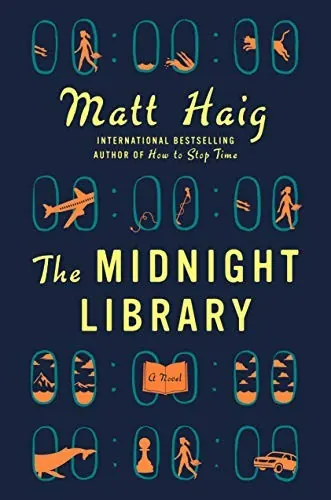
The Midnight Library
Matt Haig
Author Reading Guide
British author of The Midnight Library, one of the bestselling novels of the decade, and the mental health memoir Reasons to Stay Alive.
Matt Haig
Matt Haig is a British author whose life and work pivot on the same event: at twenty-four, living in Ibiza, he came terrifyingly close to ending his life during a breakdown. He walked back from the cliff, moved home, and slowly wrote his way out. That experience sits under nearly everything he has published since, from novels about outsiders trying to understand human life to nonfiction that speaks to millions of struggling readers with unusual directness.
His early fiction was darker and stranger than the books he is now famous for: The Last Family in England retells Henry IV with dogs, The Radleys does suburban vampires, and The Humans, from 2013, sends an alien into the body of a Cambridge mathematician to conclude, reluctantly, that peanut butter and love justify the species. Then in 2015 he published Reasons to Stay Alive, a short, blunt, warm memoir of his depression, and it became a phenomenon in the UK and far beyond, the book people hand to friends when they do not have their own words. The Comfort Book and Notes on a Nervous Planet continued in that vein.
The Midnight Library, published in 2020 into the exact anxieties of that year, made him a global bestseller on another scale entirely, with more than fourteen million copies sold. Nora Seed, stuck between life and death, finds a library where every book is a life she might have lived, and tries them on one by one: rock star, glaciologist, wife, stranger. It is a simple machine built to deliver one idea, that an ordinary life is not a failed one, and for a staggering number of readers it arrived at exactly the right moment. He followed it in 2024 with The Life Impossible, in which retired maths teacher Grace Winters inherits a house in Ibiza from a lost friend and investigates the impossible thing that happened to her there.
Honest assessment: Haig divides people. Critics find the recent novels closer to fables than fiction, with morals delivered on plates, and if you want subtext you will often find text instead. His fans would answer that clarity is the point, that he writes for the 3am version of a person, and the sales suggest the 3am audience is enormous. Both things are true. A Boy Called Christmas, from his children's books, became a genuinely charming film in 2021, which tells you how naturally his imagination bends toward fairy tale.
On this shelf he is a palate cleanser, and we mean that as a compliment. Heat level 0, no romance arc to speak of, and after three consecutive enemies-to-lovers fae wars your nervous system may thank you for him. Romantasy readers tend to be feelings-forward readers, and Haig is feelings straight, no chaser.
Across all the books, Haig is really running one long experiment with the same variables: time, mortality, and attention. The Humans asks what life looks like from outside it, How to Stop Time gives its narrator four centuries and watches him waste most of them being afraid, The Midnight Library multiplies one life into thousands, and The Life Impossible hands an elderly woman a second act she never requested. Ibiza keeps recurring too, the island where he nearly died reappearing as a place of strange grace, which is about as openly autobiographical as metaphor gets. He writes the same sermon from new pulpits, and he would probably admit it cheerfully: the sermon is that being alive is worth the trouble, and he has fourteen million receipts suggesting people need to hear it.
Where to start: The Midnight Library, which earns its reputation as a one-sitting book. Go to The Humans for something funnier and odder, and Reasons to Stay Alive if you or someone you love needs it, it is the rare bestseller that has probably saved lives. The Life Impossible is for when you finish those and want the sea to glow a little.