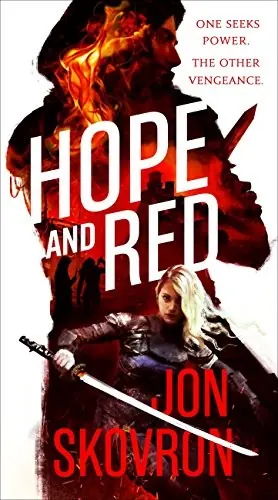
Hope and Red
Jon Skovron
Author Reading Guide
Jon Skovron writes across young adult and adult fantasy, from contemporary YA like Struts & Frets and Man Made Boy to the pirate-inflected epic Empire of Storms trilogy and the Goddess War series.
Jon Skovron
Jon Skovron came into publishing through young adult contemporary fiction and worked his way toward adult epic fantasy, which is a less common trajectory than the reverse. His first novel, Struts & Frets, arrived from Amulet in 2009 and is a music book: Sammy plays in an indie band, the Battle of the Bands looms, his grandfather is ill, and his friendship with the girl next door is complicating itself. Misfit followed in 2011, and Man Made Boy in 2013, the last of which is the one that best predicted where he was heading. Its narrator is the seventeen-year-old son of Frankenstein's monster, raised in a Manhattan theatre that shelters mythological creatures, who runs away and travels America with the granddaughter of Jekyll and Hyde. It is a road novel built out of public domain monsters, and it is very funny.
What defines his writing is voice and structure rather than worldbuilding density. Skovron writes short chapters, keeps multiple viewpoints in rotation, and favours characters who are competent at something specific and useless at everything else. He is unusually good at working-class characters in fantasy settings, people whose relationship to power is transactional rather than heroic. The prose is plain and quick. Nobody reads Skovron for lyrical description; they read him for momentum.
Empire of Storms is his first adult fantasy series and his most substantial work. Hope and Red opened it in 2016, with Bane and Shadow and Blood and Tempest following in 2017 to complete the trilogy. Hope is the only survivor of a village destroyed by imperial forces, taken in and trained as a weapon. Red is an orphan raised by the matriarch of a criminal underworld into a career as a thief and confidence man. They meet, they do not get along, and the trilogy is the long process of two very different people deciding to bring down an empire together. It has pirates, biomancers, street crime, and a genuinely satisfying ending, which trilogies do not always manage. He followed it with the Goddess War series, beginning with The Ranger of Marzanna in 2020, which leans harder into Slavic-influenced military fantasy.
On heat, this is the honest part. Skovron's books are not romances. Hope and Red carries a central relationship that develops across three volumes and delivers real emotional payoff, but on our spice scale the trilogy sits around a 1. There are references to sex, some of them frank, and no extended on-page scenes. If you want the romance to be the engine, this is not the right shelf, and we would rather tell you than let a cover mislead you.
Which brings up why he is here at all. Skovron belongs in the ancestry column rather than the recommendation column for most romantasy readers. The enemies to lovers structure he uses in Hope and Red, two damaged people from opposite social positions circling each other across a war, is the same load-bearing beam that holds up much of the current genre. Reading it shows you what that shape looks like when the romance is a subplot rather than the point. He is also a good palate cleanser: if you have read six romantasy books in a row and want a break that keeps the pirates and the found family without the heat, this works well.
Where to start: Hope and Red, and read all three Empire of Storms books, because the trilogy is designed as one long arc and book one ends mid-motion. If you would rather sample his voice in a single volume first, Man Made Boy is standalone, cheap, and gives you the humour without a three-book commitment. Readers who finish the trilogy and want more pirates should look at our collections for the seafaring shelf.