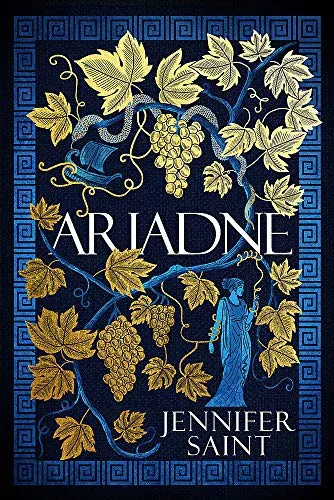
Ariadne
Jennifer Saint
Author Reading Guide
Jennifer Saint is a Sunday Times bestselling author of feminist Greek mythology retellings, including Ariadne, Elektra, Atalanta and Hera. She spent thirteen years teaching English before her debut.
Jennifer Saint
Saint grew up reading Greek myths and kept noticing the same gap. The women in those stories are constantly present and almost never asked. Ariadne hands Theseus the thread and then vanishes from the account. Elektra waits. Atalanta outruns every man sent after her and is remembered mostly for three apples. Saint taught high school English for thirteen years, which is a long time to sit with a frustration, and when she finally wrote Ariadne in 2021 the book went straight onto the Sunday Times bestseller list and was shortlisted for Waterstones Book of the Year.
Ariadne retells the Minotaur story from the perspective of the princess who made the hero's victory possible. Saint's Ariadne is a girl raised in a palace that keeps her monstrous half-brother in a maze beneath it, taught to accept her father's cruelty as weather, and given exactly one chance to choose differently. What follows is not a triumph. Theseus abandons her on Naxos, and the second half of the novel, which follows both Ariadne and her sister Phaedra into very different marriages, is where the book earns its reputation. Saint refuses to make either sister's choice look obviously correct.
Elektra followed in 2022, braiding Clytemnestra, Cassandra and Elektra around the house of Atreus and the aftermath of Troy. Atalanta came in 2023, following the huntress raised by a bear and the only woman on the Argo. Hera arrived in 2024 and is her most ambitious, taking the goddess most often written as a jealous shrew and giving her the full weight of a being who helped overthrow the previous order and then watched her husband make himself king of it. All four have been Sunday Times bestsellers, with Elektra and Atalanta reaching number one.
What defines Saint's writing is patience with anger. Her narrators are furious, but the fury is slow and domestic, expressed through what a woman does with the years between the events men consider important. Her prose is measured and slightly formal, which suits the material, and she resists the temptation to modernise her characters into contemporary voices. She is also honest about the limits of retelling. These women mostly do not escape, because the myths do not let them, and the value of the books is in watching them understand their situations completely rather than in watching them win.
On heat, Saint sits at a 0 to 1 on our spice scale. Sex happens in these books, often violently and often without consent, because that is what the source material contains, and Saint handles it soberly and off the page. There is no romance arc in the genre sense. Marriages are political, love is usually a trap, and nobody is getting an epilogue. Readers coming from steamy mythological romance will find this a completely different proposition.
For a romantasy audience she is best framed as a palate cleanser and as genre ancestry. The current wave of mythological romantasy exists downstream of Madeline Miller, and Saint is the most consistently good of the authors working that same seam. If you loved The Song of Achilles or Circe and want more of that specific feeling, she is the obvious next step, closer in tone to Circe than to anything with a spice rating. She is also a good corrective read. After a stretch of books where the powerful immortal man turns out to be secretly tender, Hera is a bracing reminder of what those stories originally looked like.
Start with Ariadne. It is her debut, the shortest and most focused of the four, and if her register does not suit you it will be clear within fifty pages. Read Elektra second if you want the Trojan War material, or skip straight to Atalanta if you would rather have an adventure with an active protagonist, since it is the most propulsive of the four. Save Hera for last. It assumes you already know the shape of these stories and rewards that familiarity more than it accommodates newcomers. The books are unconnected, so order is preference rather than requirement.