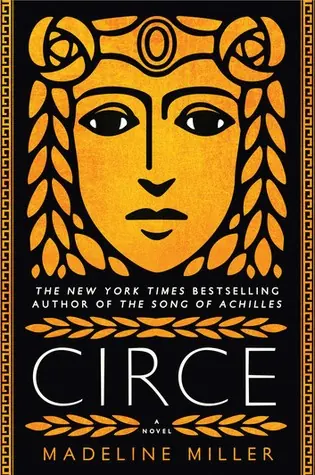
Circe
Circe is an immortal goddess exiled to a remote island, where she learns to use magic in ways no one has before. She creates a sanctuary of sorts, though gods and mortals keep finding their way to her shores, forcing her to choose between protection and connection. Her journey is one of discovering her own strength and finding power in the life she's built alone.
Everything You Need to Know About Circe
Circe is the daughter of Helios, the sun god, and the nymph Perse. She is born into a family of titans and gods who prize beauty, power, and cruelty in roughly that order. Circe has none of these things. Her voice is too mortal, her appearance unremarkable, and her temperament too soft. She is mocked by her siblings, ignored by her parents, and treated as an embarrassment to divine company.
When she discovers she has the power of pharmakeia, witchcraft, herb-craft, the ability to transform the nature of things , everything changes. She turns a fisherman she loves into a god (who immediately abandons her for a prettier nymph) and then, in jealousy and rage, transforms the nymph Scylla into the famous six-headed sea monster. Zeus notices. The gods do not tolerate power they cannot control, especially in women. Circe is exiled to the island of Aiaia, alone, forever.
The exile is where the real story begins. Centuries pass. Circe builds a life on her island, growing herbs, perfecting her craft, taming wild lions. Sailors arrive, some seeking help, others meaning harm. She learns, the hard way, what mortals and gods are capable of, and she develops the only reliable defence she has: she turns the dangerous ones into pigs.
Her island becomes a waystation for mythology's greatest hits. Daedalus arrives to build her a loom. Hermes visits as an on-and-off lover. The Minotaur crisis sends her sister Pasiphae's tragedy crashing into her solitude. Odysseus himself washes up on her shore. And finally, a choice: remain an immortal on an island, safe and alone, or risk everything for something that might actually matter.
Miller writes mythological characters as people, not archetypes. Circe's loneliness is not dramatic or poetic, it is the quiet, grinding kind. You feel the weight of centuries in her isolation and the slowly building resilience that comes from having no one to rely on but yourself.
The prose is genuinely beautiful without being overwrought. Miller has a classicist's precision and a novelist's instinct for emotional timing. Descriptions of herbs, transformation magic, and divine politics are built into character development so seamlessly that the world-building never feels expository.
The feminist reframing of Greek myth is done with intelligence rather than ideology. Circe is not retroactively made into a warrior or a politician. Her power is domestic, solitary, and creative , and Miller argues, convincingly, that this is its own form of strength. The scenes where male characters (gods, heroes, sailors) underestimate her are satisfying precisely because the book has earned them.
The Odysseus section is remarkable. Miller gives their relationship genuine chemistry and mutual respect while never pretending Odysseus is better than he is. He is brilliant, charismatic, and fundamentally incapable of staying. Circe knows it. She lets him go.
Sexual assault (a group of sailors assault Circe, this is the inciting event for her turning men into pigs). Violence from gods toward mortals and toward each other. Infanticide is discussed and threatened. A character gives birth in graphic detail. Themes of parental neglect and emotional abuse. The Minotaur sequence contains body horror. Scylla's transformation is disturbing. Descriptions of war and its aftermath. Power imbalances in sexual relationships (mortal-god dynamics).
The critical choice at the end is Circe giving up her immortality. After millennia of isolation, after Odysseus, after raising her son Telegonus, after watching mortals live and die with an intensity she envies, she chooses to become mortal herself. She uses her own pharmakeia to strip away her divinity and live a finite life with Telemachus (Odysseus's son by Penelope).
The Telegonus-Telemachus swap is one of the book's boldest moves. Circe's son Telegonus fulfils the prophecy by accidentally killing Odysseus with a stingray-spine spear. He then brings Penelope and Telemachus to Aiaia. Penelope and Circe form an unexpected alliance. Telemachus, quiet and thoughtful where his father was loud and cunning, becomes the partner Circe never had.
The transformation of Scylla haunts the entire book. It is Circe's original sin , an act of jealous rage that created a monster responsible for thousands of deaths across centuries. Her guilt drives much of her character development.
Athena emerges as the book's most dangerous antagonist, not through direct conflict but through her cold, strategic willingness to use mortals as pieces in divine games. The tension between Circe and Athena in the final act is about whether love or power is the more durable force.
If you loved Madeline Miller's The Song of Achilles and want more, this is the natural next read, though the tone is quite different. Where Achilles is a love story, Circe is a coming-of-age that spans millennia.
Readers who enjoy literary fantasy . Piranesi, The Golem and the Jinni, Jonathan Strange and Mr Norrell, will find a kindred spirit here. It also works for readers who love mythology but find straight retellings dry.
This may not be for you if you want fast-paced plot. Circe is contemplative and episodic. Long stretches focus on Circe alone on her island, and the pace is driven by character growth rather than external events. Readers who want romance at the centre will find it present but not dominant.
Circe is a standalone novel. It exists in the same mythological framework as Miller's The Song of Achilles but is not a sequel. Characters from Achilles (Odysseus, Achilles in reference, Patroclus) appear or are mentioned in Circe, but the books can be read in any order.
Reader Reviews
No reader reviews yet. Be the first!