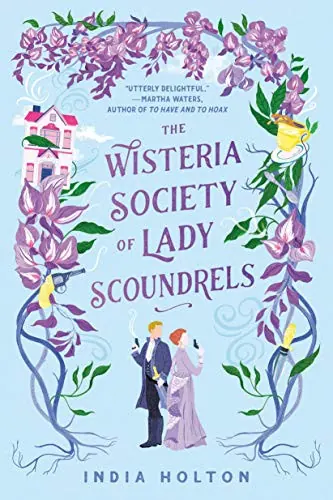
The Wisteria Society of Lady Scoundrels
India Holton
Author Reading Guide
India Holton is a New Zealand author of Victorian fantasy romantic comedy, best known for the Dangerous Damsels books about flying houses, criminal ladies, and extremely polite violence.
India Holton
Holton debuted in 2021 with The Wisteria Society of Lady Scoundrels and immediately staked out territory nobody else was occupying: nineteenth-century England, except the pirates are respectable women, the houses fly, and everyone is unfailingly courteous while committing crimes. The Dangerous Damsels series continued with The League of Gentlewomen Witches in 2022 and The Secret Service of Tea and Treason in 2023, and she opened a new line, Love's Academic, with The Ornithologist's Field Guide to Love in 2024. She writes national bestsellers in a register most of the genre has abandoned, which is comedy.
What defines her writing is the sentence. Holton is a genuine stylist working in a mode that borrows from Wodehouse and Austen without doing an impression of either. Her jokes are structural, buried in the rhythm of a paragraph rather than delivered as banter, and she is capable of an emotionally precise line landing three words after a ridiculous one. The plots are deliberately absurd. The feelings underneath them are not. That combination is much harder than it looks, and it is why readers who love her tend to love her disproportionately while readers who want their fantasy earnest bounce off within a chapter.
The Wisteria Society of Lady Scoundrels introduces Cecilia Bassingwaite, a well-mannered young lady of a piratical family, and Ned Lightbourne, the assassin sent to kill her. The society of the title is a group of criminal gentlewomen who take tea seriously and property law less so. The League of Gentlewomen Witches turns to the rival organisation, and The Secret Service of Tea and Treason moves the comedy into espionage with a fake-marriage assignment. The Ornithologist's Field Guide to Love steps into a different frame entirely: two rival Victorian ornithologists competing to find a rare magical bird, pushed together by publicists who want the publicity. It is the closest she comes to the academic rivalry romance that Ali Hazelwood popularised, run through her own pirate adjacent sensibility.
On heat, Holton sits around a 1 to 2 on the book spice ratings used here. There is real physical tension, some of it quite charged, and the explicit content is limited. She generates heat through restraint and wordplay rather than description, which suits the period voice and will still frustrate anyone looking for open-door scenes. Her enemies to lovers arcs are among the funniest in the genre precisely because the antagonism is verbal and both parties are enjoying themselves.
She matters to a romantasy audience as a corrective. The genre currently runs heavily toward the serious, the fated, and the tragic, and a lot of readers hit a wall where every book starts to feel like the same book at a different volume. Holton is the reset. She is also proof that fantasy romance can be light without being slight; the books have real craft in them and reward rereading in a way that faster-paced titles often do not. If you have been reading nothing but dark fae courts for six months, this is what to reach for.
It is worth adding that Holton is genuinely funny in print, which is rarer than the number of books marketed as romantic comedies would suggest. Most of those books are warm rather than witty. Holton actually constructs jokes, sets them up chapters in advance, and lands them without nudging the reader. If that sounds like a small thing, count how many fantasy novels have ever made you laugh out loud.
Where to start: The Wisteria Society of Lady Scoundrels, which is both the debut and the purest expression of what she does. The Dangerous Damsels books follow overlapping casts and read best in order. The Ornithologist's Field Guide to Love is a completely separate entry point with no prior reading required, and it is arguably the better start for readers who want the humour but find flying houses a step too far. Try a sample first either way; her voice is distinctive enough that you will know inside ten pages.