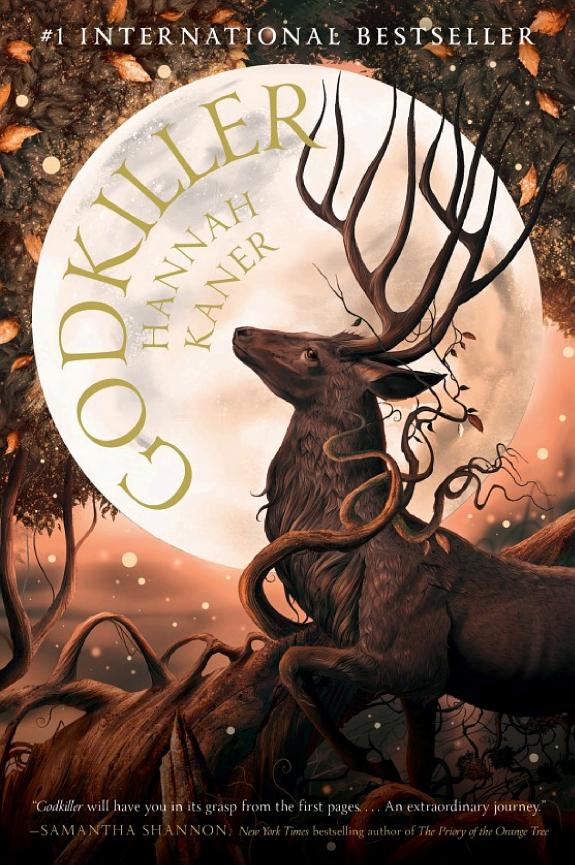
Godkiller
Hannah Kaner
Author Reading Guide
Hannah Kaner is the English author of the Fallen Gods trilogy, which began with the #1 Sunday Times bestseller Godkiller. She writes from Edinburgh and has been shortlisted for the Hugo, Locus, and British Fantasy Awards.
Hannah Kaner
Hannah Kaner published Godkiller in 2023 and went straight to number one on the Sunday Times list with it, which almost never happens to a debut fantasy novel. The premise did a lot of the work. In a country where the gods have been outlawed after a war they caused, Kissen kills them for a living, and she is very good at it. Then she picks up a noble girl bonded to a small god of white lies, a baker's apprentice with a secret, and the beginnings of a group she has no interest in keeping. The book runs under four hundred pages, moves constantly, and refuses to spend a chapter explaining itself.
The trilogy completed quickly by genre standards. Sunbringer followed in 2024 and Faithbreaker in 2025, all three of them international bestsellers, with the work translated into sixteen languages and shortlisted for the Hugo, Locus, British Book, and British Fantasy Awards. What holds the three books together is Kaner's handling of belief as a physical system. Gods in this world exist because people make offerings to them, they grow strong on attention, and they die when they are forgotten. That gives the political conflict real teeth, because banning worship is not censorship, it is execution.
The other thing that defines the writing is Kissen herself. She is an amputee, she is queer, she is genuinely unpleasant to be around for much of the first book, and Kaner never sands any of that down into inspiration. Her prosthetic is a practical concern that affects how fights go. Her anger is earned and does not resolve neatly. Around her, the found family builds slowly and unwillingly, which is what makes it convincing rather than sentimental. The gods themselves are among the best things in the series, particularly Skedi, a god of small lies the size of a hare who is far more dangerous than he looks. Kaner writes them as needy, petty, and frightening in roughly equal measure, which is a much harder balance to hold than making them either benevolent or monstrous. Elogast, the retired knight turned baker who joins the group, provides the counterweight, a man who did terrible things in service of a king he still loves and who is quietly falling apart about it.
On the heat question, Kaner sits at roughly a 0 to 1 on our book spice ratings. There are queer relationships across the trilogy, there is real tenderness, and there is essentially nothing explicit. These are adventure fantasy novels with romance as a thread rather than a structure. Readers arriving from the heavier end of romantasy should treat this as a change of register rather than a disappointment, because the emotional payoff is substantial even without the heat.
For a romantasy audience, Kaner is the writer to reach for when you want the pace and the character bonds of the genre without the relationship being the entire load bearing wall. The morally gray protagonist here is not a brooding love interest, she is the point of view character, and the books are honest about what her line of work costs her. That is a useful corrective after a run of books where moral complexity is mostly aesthetic. Kaner also writes short, which matters when the genre trends toward six hundred pages as a default.
Start with Godkiller and read the trilogy in publication order, since Sunbringer picks up almost immediately and Faithbreaker resolves threads planted in the first fifty pages of book one. There is no reason to skip around. A new trilogy with HarperVoyager has been announced, with the first volume, A Snake Among Swans, scheduled for release in 2026, so this is a good time to catch up. If you liked the crew dynamics and heist energy of Six of Crows but wanted gods in it, Kaner is a strong recommendation.