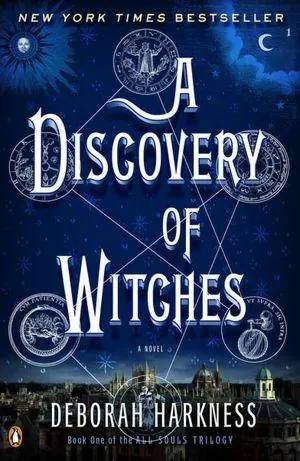
A Discovery of Witches
Deborah Harkness
Author Reading Guide
Deborah Harkness is the historian turned novelist behind A Discovery of Witches and the All Souls series, which sent a Yale historian-witch and a 1,500-year-old vampire geneticist through the Bodleian Library, Elizabethan London, and five bestselling books.
Deborah Harkness
Deborah Harkness was a history professor before she was a novelist, and she never really stopped being one. A scholar of the history of science and magic at the University of Southern California, she had already won serious academic prizes when, in 2011, she published A Discovery of Witches, reportedly sparked by an airport-bookstore musing about why vampires were suddenly everywhere and what they might actually do for a living. The novel opens with Diana Bishop, a Yale historian of alchemy and a deeply reluctant witch, accidentally calling up an enchanted manuscript, Ashmole 782, in Oxford's Bodleian Library. Every creature in the hidden world wants that book, including Matthew Clairmont, a vampire geneticist with fifteen centuries of baggage and excellent taste in wine. The novel became a global bestseller, and the trilogy completed with Shadow of Night (2012) and The Book of Life (2014).
What makes Harkness different from nearly everyone else on this site is that the history is real. Shadow of Night drops Diana and Matthew into Elizabethan London among the School of Night, with walk-ons from Christopher Marlowe and Queen Elizabeth herself, and Harkness writes that world with the confidence of someone who has spent her whole career in its archives. The wine Diana drinks, the alchemy she studies, the way a sixteenth-century household actually functioned: it is all load-bearing detail. For readers, this cuts both ways. The texture is unmatched, and the pacing pays for it. These are long, unhurried books where characters discuss manuscript provenance at length between supernatural crises, and you need to be the kind of reader who enjoys exactly that.
The series kept growing after the original trilogy. Time's Convert (2018) followed Matthew's son Marcus through the American and French Revolutions alongside his modern romance with the young witch Phoebe as she undergoes the transformation into a vampire herself. The Black Bird Oracle (2024) brought Diana back to center stage, pulled toward her family's darker legacy of higher magic and the Proctor side of her ancestry, and it reads like Harkness rediscovering what made the first book work; she has called it her most personal entry. There was also television: A Discovery of Witches ran for three seasons (2018-2022) with Teresa Palmer and Matthew Goode, and it remains one of the better book-to-screen adaptations in this genre, faithful where it counts and gorgeously cast.
On our 0-5 spice scale, the All Souls books sit at a 2. The romance between Diana and Matthew is intense, possessive in ways some readers find swoony and others find dated, and the physical side is written warmly but without much explicit detail. Matthew's overprotectiveness is the series' most divisive element; Harkness interrogates it somewhat, but readers allergic to controlling vampire boyfriends should know going in that it is a feature, not a bug.
For romantasy readers, Harkness matters as the bridge between Twilight-era vampire romance and the bookish, academia-flavored fantasy that came after. Diana is the blueprint for the scholar heroine: a grown woman with a career, a fellowship, and rowing calluses, whose love story runs through libraries rather than ballrooms. If dark academia and enemies-to-lovers-in-the-stacks are your thing, this is one of the founding texts, written by an actual academic with actual tenure, which is a flex nobody else in the genre can match.
Start with A Discovery of Witches and read in publication order: the original trilogy, then Time's Convert, then The Black Bird Oracle. Do not skip Shadow of Night even if time travel is not usually your taste; it is the series' high point. Best consumed slowly, ideally with a glass of whatever Harkness would recommend. She used to run an award-winning wine blog, and the woman has opinions.