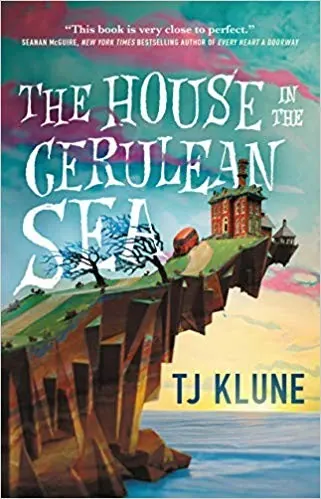
The House in the Cerulean Sea
Linus works for a secret government agency that monitors dangerous magical children, but he discovers kindness and belonging at a house full of misfits. His found family teaches him that goodness still exists in the world, and that acceptance is more powerful than fear. A cosy, heartwarming fantasy about choosing love over duty.
Everything You Need to Know About The House in the Cerulean Sea
Linus Baker is a middle aged caseworker for the Department in Charge of Magical Youth, a man with a rulebook, a cat and a life the color of wet cardboard. Extremely Upper Management sends him to Marsyas Island for a month to assess a classified orphanage. Six children live there: Talia the gnome with a shovel and a grudge, Theodore the wyvern who hoards buttons, Phee the forest sprite, Sal who turns into a Pomeranian when he is frightened, Chauncey the amorphous blob who dreams of being a bellhop, and Lucy, a cheerful six year old who happens to be the Antichrist. Their caretaker is Arthur Parnassus, patient and immovable. Linus arrives to file a report and slowly works out that the danger in the file was never the children. It is a soft book about bureaucratic cruelty and choosing a family, and it is not trying to be anything else.
This book is pure heart. The found-family dynamic works because the kids are funny, strange, and deeply lovable, not saccharine substitutes. The slow-burn romance between Linus and Arthur never feels rushed. The worldbuilding is light but clever: a modern-adjacent world where supernatural beings are marginalized and feared, but the horror is in the bureaucracy, not the creatures. Klune nails magical comedy without making it cutesy. The ending is earned and genuinely satisfying, with no cheap emotional shortcuts.
Minimal violence. References to child endangerment (as bureaucratic concern, not graphic). One major character dies (not a main character), handled with grace. Grief, loss, and themes of institutional neglect appear throughout but aren't dwelled on.
Arthur is a phoenix, and he grew up in that same orphanage, kept in a cage in the basement by the department Linus works for. That reveal reframes his protectiveness completely. Linus and Arthur do end up together, though the romance stays gentle and closed door rather than explicit. Lucy is never a threat to anyone, the department simply needed one to justify itself. Linus goes back to the city, quits, sells his house and returns to the island for good. The village comes around. Nobody dies.
If you liked Howl's Moving Castle or Sorcery of Thorns, you'll connect with this. It's for readers who want romance with heart, found family that feels real, and slow-burn tension that pays off. Not for you if you need dark tone or edge, this is warm and genuinely hopeful. The magical elements are secondary to the character work, which might frustrate readers looking for complex magic systems.
Reads as a complete standalone with no cliffhanger. TJ Klune later published a sequel, Somewhere Beyond the Sea, told from Arthur's point of view, but book one resolves fully and you can happily stop here.
Reader Reviews
No reader reviews yet. Be the first!