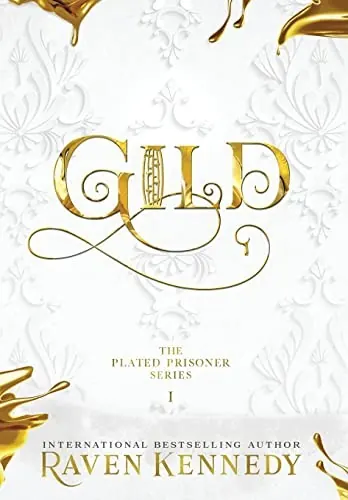
Gild
A woman is held captive in a golden tower by a paranormal being who demands she turn all she touches to gold. Her captivity becomes complicated by obsession, dark desire, and forbidden attraction. She must decide if freedom means leaving the only world she has ever known.
Everything You Need to Know About Gild
Auren has been caged for ten years. She is the favoured possession of King Midas, the man with the golden touch , kept in a gilded cage in his castle, displayed as proof of his power and his wealth. Her skin shimmers gold. She is his trophy, his secret, and his prisoner, though he calls her his beloved.
When a rival king invades and captures Auren as a spoil of war, she is ripped from the only world she has known, even if that world was a cage. The army that takes her is led by Commander Rip, a fearsome figure with dark power and a reputation for cruelty. He is not what the stories said.
Auren has spent a decade convincing herself that Midas loves her, that the cage is protection, that her gilded life is a gift rather than a sentence. Away from him for the first time, surrounded by soldiers who treat her as a person rather than an object, she begins to see the truth she has been avoiding. The gold is not a blessing. Midas is not a saviour. And the power Auren has been suppressing is not his, it is hers.
The cage metaphor is masterfully literal. Plum takes the fairy tale of King Midas and turns it into a story about coercive control, and the slow awakening of a woman who has been manipulated into believing her prison is a palace.
Auren's deprogramming is handled with nuance. She does not suddenly see the truth, she resists it, rationalises, defends Midas, and only gradually, painfully, recognises the abuse. Plum writes this arc with empathy rather than judgement.
Commander Rip is an excellent subversion. Expected to be the villain, he treats Auren with more respect than the man who claimed to love her. The dynamic between them is slow-burn and charged with the tension of Auren's conflicting loyalties.
The world-building , a world of perpetual winter and gold, with courts based on precious metals, is visually striking and atmospherically rich.
Captivity and coercive control presented in detail. An abusive relationship portrayed sympathetically from the victim's perspective (this is intentional and part of the narrative arc). Sexual content (moderate, escalates in later books). A woman treated as property. Themes of gaslighting, isolation, and the slow recognition of abuse. Violence and warfare. A character discovers her own power has been suppressed by her captor.
The turning point is Midas himself. To seal a military alliance, he agrees to loan Auren to King Fulke for one night, the same Auren he claims to love and protect. That moment cracks her gilded loyalty open, because a man who loves you does not trade you.
Midas says he gilded Auren with his golden touch, and she has spent ten years believing her shimmer is his mark on her. The series slowly dismantles that story. The power was never his.
The ending is a capture, twice over. On the road to Fifth Kingdom, Auren's caravan is attacked by the Red Raids, snow pirates who kill Sail, one of the only guards who treated her like a person. Then Fourth Kingdom's army sweeps in and takes the survivors. Auren ends the book as a prisoner of Commander Rip, the enemy she was raised to fear, marching away from everything Midas built around her.
Gild is the first book in The Plated Prisoner series (five books). The series follows Auren's journey from captive to autonomous. Read in order, the character development is cumulative and the romance is a slow burn across multiple books.
Reader Reviews
No reader reviews yet. Be the first!