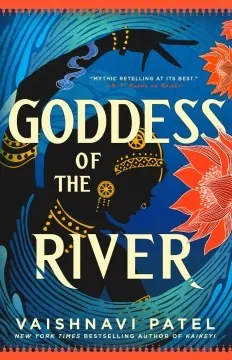
Goddess of the River
Vaishnavi Patel
Author Reading Guide
Vaishnavi Patel is the New York Times bestselling author of Kaikeyi, a civil rights lawyer who spends her off-hours handing the microphone to the women that Indian epics spent centuries blaming.
Vaishnavi Patel
Patel arrived in 2022 with Kaikeyi, a debut that had no business behaving like a debut. Orbit published it, it climbed to number 14 on the New York Times hardcover fiction list, and it picked up nominations for both the Goodreads Choice Award for Fantasy and the Goodreads Choice Award for Debut Novel, plus a 2023 Ignyte nomination for Best Adult Novel. The premise is the kind of thing that sounds like a thesis and reads like a knife: retell the Ramayana from the perspective of Kaikeyi, the queen who demanded Rama's exile and has been the story's designated villain for roughly three thousand years. Patel is a practicing lawyer working in constitutional law and civil rights litigation, and it shows in the book's spine. She builds a case.
What defines her writing is patience with interiority. Patel does not write action sequences that pop; she writes decisions that cost. Her prose is plain in the best sense, unhurried, closer to Madeline Miller than to anything on the current fantasy bestseller shelf. She writes at the intersection of Indian myth, feminism, and anti-colonialism, and she refuses the easy version of that project, where the reclaimed woman is simply good and everyone who condemned her was simply wrong. Her Kaikeyi is politically shrewd, sometimes cruel, and genuinely responsible for the consequences she sets in motion. Patel lets her be culpable and sympathetic at once, which is far harder to pull off than either alone. Readers who like their protagonists morally gray will find her a very different flavour of that than the fae princes they are used to.
Kaikeyi is the entry point and the strongest argument for her. It gives its heroine a magic rooted in perceiving and adjusting the invisible bonds between people, which turns court politics into something tactile, and it treats the Ramayana as living material rather than a museum piece. Goddess of the River followed in 2024, retelling threads of the Mahabharata through Ganga, the river goddess, and her doomed mortal son. It is the sadder book and the more formally ambitious one, moving at the pace of a river rather than a plot, and it asks what a mother owes a child she cannot save. You can find it on the site at Goddess of the River. Her third novel, Ten Incarnations of Rebellion, arrived in June 2025 and stepped sideways out of myth entirely into alternate history: an India never liberated from British rule, a city called Kingston built on the ashes of Bombay, and a young woman named Kalki Divekar who takes a job inside the empire in order to take it apart. Its ten sections mirror the Dashavatara, the ten avatars of Vishnu, spread across a decade of one life.
On heat, be clear-eyed before you buy. Patel sits at the very bottom of the book spice ratings used here, a 0 to 1 depending on the title. There are marriages, there is longing, there is physical tenderness, and there is nothing on the page. Romance is not the engine of any of these novels. If you came to fantasy through Fourth Wing and you need a love interest to organise your reading around, going in expecting one will only make you resent a very good book for failing to be a different book.
So why does she belong on a romantasy site at all? Because a large share of the genre's readers arrived through mythological retelling, and Patel writes the literary end of that lineage. If you loved the Hades and Persephone wave and then found yourself curious about what a retelling looks like when the source material is a national epic rather than a Wikipedia summary of Greek gods, this is the shelf. She is also the ideal palate cleanser between spicy series, the book you read when three enemies-to-lovers arcs in a row have started to blur. Read her the way you would read Circe or The Song of Achilles.
Where to start: Kaikeyi, no question, and read it slowly. If it works on you, go to Goddess of the River next, since it is the closest sibling in tone and subject. Save Ten Incarnations of Rebellion for last, because it is the one that asks the most of you and rewards a reader who already trusts her. Nothing needs to be read in sequence; there is no shared world and no continuing cast. If you are not sure whether a low-heat mythic retelling fits your current mood, the reader quiz will point you somewhere with more fire in it.