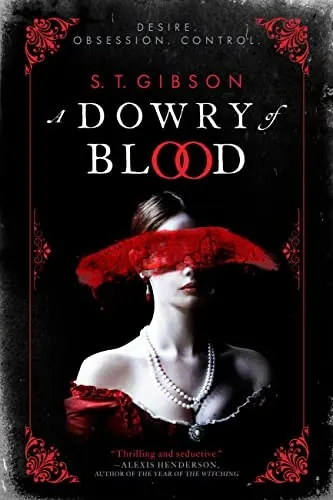
A Dowry of Blood
S.T. Gibson
Author Reading Guide
S.T. Gibson writes seductive, morally slippery gothic fiction, from the cult vampire novel A Dowry of Blood to the dark academia of An Education in Malice.
S.T. Gibson
Gibson took a creative writing degree at the University of North Carolina at Asheville and a Master of Theological Studies at Princeton Theological Seminary, which is a strange pair of credentials until you read her, at which point it makes complete sense. A Dowry of Blood began as an independent release, built a genuine cult following, and was picked up for wider publication, eventually landing her on the Sunday Times bestseller list. An Education in Malice followed in 2024, and An Encore of Roses serves as an epilogue to the Dowry world. Her influences are stated plainly and worth knowing: Angela Carter's The Bloody Chamber and Catherynne M. Valente's Deathless.
What defines her writing is voice. A Dowry of Blood is written as a letter from Constanta to the husband who made her a vampire and ruined several centuries of her life, and the entire novel operates in that second-person address. It is furious, adoring, and unreliable in the way that only someone still in love with their abuser can be. Gibson writes desire and control as the same impulse, and she does not resolve that tension into a comfortable lesson. Her sentences are lush without being slow, and she keeps her books short, which is a deliberate choice; the intensity would not survive four hundred more pages. Readers who want gothic atmosphere with actual teeth in it, rather than mist and candles as set dressing, are her audience.
An Education in Malice moves to Saint Perpetua's College in Massachusetts, where Laura Sheridan falls into an academic rivalry with the beautiful and infuriating Carmilla and both of them are drawn into the orbit of their poetry professor, De Lafontaine, who has her own dark fixation. It is the more explicitly sensual of the two and the more straightforwardly enjoyable, working the dark academia mode at full strength: poetry seminars, blood, competitive brilliance, and a power imbalance the book examines rather than excuses. The Carmilla name is not a coincidence; Gibson is in conversation with Le Fanu throughout.
On heat she varies more than most authors on this shelf. A Dowry of Blood is sensual and intensely charged but relatively restrained on the page, roughly a 2. An Education in Malice is more explicit, closer to a 3 on the spice scale, with content that includes blood-play and power exchange. Both books are queer and polyamorous in structure rather than as a footnote. Content warnings matter here more than usual: coercive control, emotional abuse, and violence are central subjects, not background, and Gibson writes them without softening.
She matters to a romantasy audience as the literary edge of the vampire revival. Anne Rice built the template, and Gibson is one of the few contemporary writers extending it rather than imitating it, taking the same interest in immortality as a slow psychological catastrophe and adding a much sharper view of consent. She is also short, which makes her the ideal author to read when you want intensity without a fifty-hour commitment. Readers who found the current fae-court wave emotionally flat and want something that actually unsettles them should start here.
Worth flagging for anyone recommending her: Gibson is not a comfort read and does not want to be. The pleasure on offer is closer to what a good horror novel provides than to what most of this shelf trades in, and readers who want reassurance at the end of a book should look elsewhere.
Where to start: A Dowry of Blood, and read it in one or two sittings, because the epistolary voice loses momentum if you put it down for a week. An Encore of Roses is best read after, as intended. An Education in Malice is unconnected and works as a completely separate entry point, and it is the friendlier of the two for readers who want the atmosphere without the sustained study of an abusive marriage. Neither requires the other.