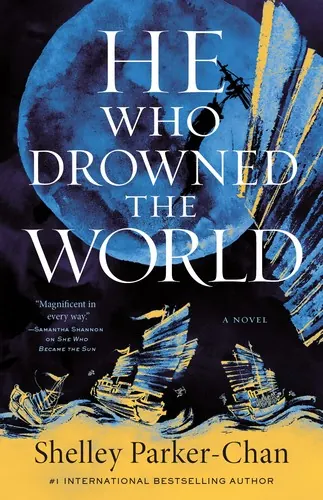
He Who Drowned the World
Shelley Parker-Chan
Author Reading Guide
Shelley Parker-Chan is the Australian author of She Who Became the Sun, a #1 Sunday Times bestseller that reimagines the founding of China's Ming dynasty. They won the Astounding Award for Best Debut and two British Fantasy Awards.
Shelley Parker-Chan
Shelley Parker-Chan
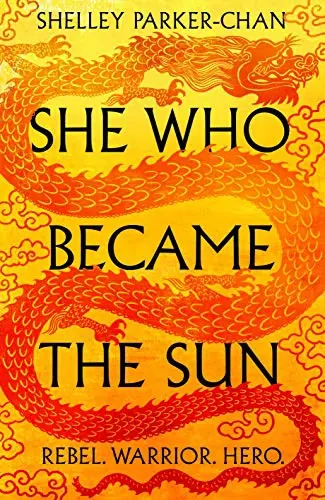
Shelley Parker-Chan spent years working in international development across Southeast Asia before publishing She Who Became the Sun in 2021, and that background shows in how they write power. The novel took the rise of the Ming dynasty's founding emperor and asked what happens if the person who took that throne was a peasant girl who stole her dead brother's name, his fate, and his claim to greatness. It became a #1 Sunday Times bestseller, was translated into fifteen languages, and won Parker-Chan the Astounding Award for Best Debut along with the British Fantasy Awards for Best Fantasy Novel and Best Newcomer.
What defines the writing is a refusal to let anyone off the hook. Zhu Chongba is not a scrappy underdog who deserves the throne. She is a person who decides she wants greatness and then does whatever the pursuit of it requires, including things the reader will not forgive. The book is interested in desire as a destructive force, in gender as something performed under threat rather than discovered joyfully, and in the specific loneliness of people who have made themselves into weapons. Parker-Chan writes prose that is spare and unsentimental until it suddenly is not, and the emotional detonations land harder for the restraint around them.
He Who Drowned the World, published in 2023, closes the Radiant Emperor duology and is the harder of the two books. It widens the frame to give equal weight to Ouyang, the eunuch general whose story runs in parallel to Zhu's, and to Madam Zhang, whose ambition operates entirely through the men around her. It is a book about people destroying themselves and each other in pursuit of things that will not satisfy them. Readers who wanted the second half to soften into triumph do not get that. The morally gray label undersells it, since almost nobody in this duology is doing anything defensible, and the narrative does not pretend otherwise.
On heat, Parker-Chan sits at roughly a 2 on our spice scale, and the number is misleading without context. There is explicit content, some of it graphic, and almost none of it is written to be enjoyable. Sex in these books is about power, humiliation, and control. Ouyang's arc in particular includes material that will be difficult for many readers. This is not romantasy in any recognisable sense. It is historical fantasy with romantic and sexual material used as instruments of the tragedy. Anyone picking it up expecting a love story should reset before starting.
The reason a romantasy reader should still care is that these books demonstrate the ceiling of what the wider genre space can do with the same raw ingredients. Court politics, a protagonist whose identity is a survival strategy, a destined role claimed rather than granted, an antagonist who understands the protagonist better than anyone else does. All of that is standard genre furniture, and Parker-Chan uses it to build something that reads as literary fiction. Treat this as the palate cleanser you go to after a long stretch of comfort reads, when you want a book that will not comfort you at all.
Read She Who Became the Sun first and give it fifty pages, because the opening famine sequence sets a tone that some readers mistake for the whole book. Then read He Who Drowned the World when you have the capacity for it, since it is bleaker and structurally more demanding. There is no third book and none is needed. If you got on with the brutality and ambition of The Poppy War or the historical anger of Babel, this duology belongs on the same shelf and arguably outclasses both on a sentence level. If you bounced off those, this will not convert you.