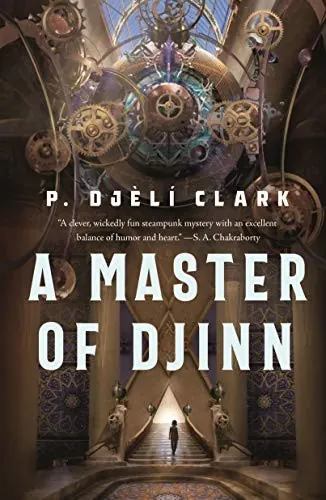
A Master of Djinn
P. Djèlí Clark
Author Reading Guide
P. Djeli Clark writes historical fantasy that rewrites real history with djinn, spirits and hidden magic, and he has the Nebula, Locus, Compton Crook and Ignyte awards to show for it. Romance is almost never his engine, but the worldbuilding is some of the sharpest in modern fantasy.
P. Djèlí Clark
P. Djeli Clark is a pen name for a working historian, which explains a great deal about how his books are built. He came up through short fiction, and for several years he was primarily known as a novella writer, which is a hard place to build a career from. The Black God's Drums and The Haunting of Tram Car 015 both landed on award ballots and both are under two hundred pages. Ring Shout, published in 2020, is the one that made the wider fantasy audience pay attention: a Ku Klux Klan story where the monsters are literal, set in 1920s Georgia, and it is as angry and as funny as that description suggests.
His first full novel, A Master of Djinn, arrived in 2021 through Tor and won the Nebula Award for Best Novel, the first steampunk work ever to take that category. It also won the Locus Award for First Novel, the Compton Crook Award and an Ignyte, and it was nominated for the Hugo. That is an unusual amount of hardware for a debut novel, and it is deserved.
What defines his writing is the collision of rigorous historical detail with a very loose attitude toward what history was allowed to be. A Master of Djinn is set in an alternate Cairo in 1912 where a Sudanese mystic cracked open a door to the djinn forty years earlier, and Egypt consequently became a world power instead of a colony. Clark takes that premise seriously at the level of infrastructure, politics, labour and fashion, and then runs a murder mystery through it. His books are procedural in shape, which keeps the worldbuilding from turning into a lecture. Somebody is always investigating something.
The specifics are the pleasure here. Agent Fatma el-Sha'arawi works for the Ministry of Alchemy, Enchantments and Supernatural Entities, wears immaculate English suits, and is very tired of being underestimated. The case involves a man claiming to be a long-dead mystic, a secret brotherhood, and an escalating series of very bad decisions by people who should know better. There is a queer relationship threading through the book that is treated as unremarkable by the narrative, which is quietly one of the best things about it. The short fiction set in the same world, particularly A Dead Djinn in Cairo, is worth reading first if you want to meet Fatma before the novel.
On heat, this is honest ground for a spice scale of 0 to 1. There is affection and there is an established relationship, but nothing on the page. Clark is writing genre fantasy with a romance thread, not romance. If you come to him expecting the emotional structure of a romantasy novel you will be reading against the grain of the book and you will not enjoy it.
Why he matters to readers of this site is a fair question, and the honest answer is that he does not belong to this genre at all. He is here as ancestry and as a palate cleanser. Romantasy readers burn out, usually somewhere around the fourth consecutive fae court, and Clark is one of the best available resets: the same appetite for invented worlds, none of the romantic obligation, and prose that will make the next romantasy you read feel a little thin by comparison. He is also a useful comparison point for anyone who liked Babel and wants more historical fantasy that has an argument to make.
Where to start: read the novelette A Dead Djinn in Cairo, then A Master of Djinn. If the alternate-history angle is not for you, Ring Shout is a completely separate standalone and the better book to try instead. Nothing in his catalogue requires a large time commitment, which makes him low risk to sample. Not sure whether he fits your taste? Our reading quiz will tell you fairly quickly whether you want fantasy with the romance dialled all the way down.