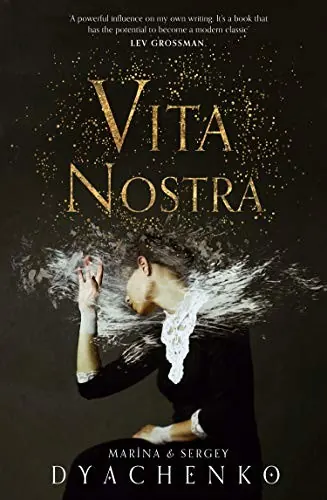
Vita Nostra
Marina Dyachenko
Author Reading Guide
Marina Dyachenko is a Ukrainian-born fantasy author who wrote more than thirty novels with her late husband and co-author Sergey, including the cult dark academia classic Vita Nostra.
Marina Dyachenko
Marina Dyachenko started out on stage, not on the page. A trained actress from Kyiv, she began writing with Sergey Dyachenko, a psychiatrist turned screenwriter, in the mid-1990s. The two married and built one of the most decorated partnerships in European speculative fiction, producing more than thirty novels along with screenplays and short fiction, and taking the Best Authors of Europe award at Eurocon in 2005. They moved from Ukraine to California in 2013. For most of their career their work was barely available in English. That changed when one book crossed over and slowly became a word-of-mouth phenomenon among readers hungry for something stranger than the usual magic school story.
That book is Vita Nostra, translated into English in 2018 by Julia Meitov Hersey. It follows Sasha Samokhina, a teenager coerced through escalating, impossible demands into enrolling at the Institute of Special Technologies in the remote town of Torpa, where the coursework seems like nonsense, failure is punished through harm to her family, and the true curriculum turns students into something other than human. Calling it dark academia is accurate but undersells it. It is a book about transformation, fear as a teaching tool, and language as the raw code of reality, and it reads like nothing else in our database.
The Dyachenkos write fantasy that behaves like literary fiction. Their signature move is psychological pressure: ordinary people pushed past their breaking point by systems they cannot refuse, with the fantastical elements working as metaphors made flesh. English readers can also find The Scar, published in translation in 2012, an earlier standalone about a swaggering duelist cursed with all-consuming cowardice who has to rebuild himself from nothing, and Daughter from the Dark, released in 2020, about a DJ saddled with an unnerving otherworldly child. Each one takes a single what-if and follows it with total commitment. Their catalog in Russian and Ukrainian ranges far wider, from fairy tale retellings to psychological science fiction, and English translations continue to trickle out, with readers of translated fiction treating each new Julia Meitov Hersey translation as a small event.
The long-awaited sequel to Vita Nostra, Assassin of Reality, reached English readers in 2023 and continues Sasha's story deeper into the Institute's metaphysics. Sergey died in 2022, and Marina has carried their shared catalog forward since. The books keep finding new readers through BookTok, where Vita Nostra circulates as the standing answer to "I loved dark academia, what next?" It is a genuine cult classic in the old sense: passed hand to hand, argued about, reread, and recommended with the warning that it will make no sense for the first hundred pages and that this is somehow part of the pleasure.
Now the honest part: on our spice scale this is a flat 0. There is longing in Vita Nostra, and Sasha has relationships that matter, but nothing here is written for heat. If you want kissing books, these are not kissing books. They are what you read between kissing books when you want your brain taken apart and reassembled. That said, the emotional intensity is real: Sasha's entanglement with her terrifying teachers and her fellow students carries an obsessive charge that fans of toxic academy dynamics will recognize, even with the physical side entirely absent.
Where to start is easy: Vita Nostra first, no exceptions, then Assassin of Reality if it hooks you. The Scar works as a standalone entry if you prefer classic secondary-world fantasy over contemporary settings. Come to it when the academy settings in romantasy have left you wanting a school where the stakes are existential instead of romantic, and expect to think about it for weeks afterward. Both Vita Nostra books reward slow, attentive reading, so give them evenings rather than lunch breaks.