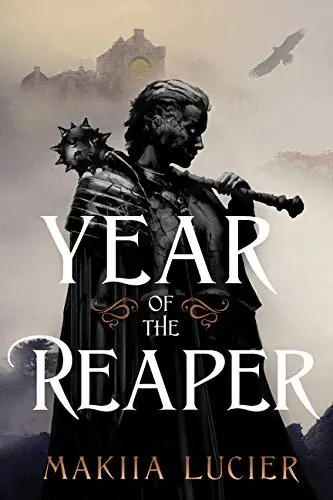
Year of the Reaper
Makiia Lucier
Author Reading Guide
Makiia Lucier writes historical and mythology-rooted YA fantasy where the romance simmers and the research shows. Closed-door, character-first, and consistently shorter than everything else on the shelf.
Makiia Lucier
Makiia Lucier came to fiction sideways. She grew up on the Pacific Island of Guam and holds degrees in journalism and library studies from the University of Oregon and the University of Wisconsin-Milwaukee. Her debut, A Death-Struck Year (2014), was straight historical fiction about the 1918 influenza epidemic in Portland, and it set the pattern for everything after: real history first, magic second, romance third but never absent. She now lives in Portland, Oregon, and has built a career that sits slightly outside the romantasy mainstream while appealing to a lot of the same readers.
What defines her writing is restraint. Lucier writes short books by fantasy standards and she does not pad. The prose is clean and plain, the chapters are tight, and she tends to resolve a mystery rather than escalate a war. Reviewers have reached for words like brilliant (Booklist), masterful (Horn Book), and breathtaking (School Library Journal). Readers who need a fast-moving plot with a rising body count will find her slow. Readers who want fantasy that feels like it was researched by a librarian, because it was, tend to become loyal.
Isle of Blood and Stone (2018) and Song of the Abyss (2019) form a loosely connected pair built around cartography, missing princes, and old maps that hide messages nobody was meant to read. Year of the Reaper (2021) is her most recommended standalone: a young lord returns home after three years in an enemy prison and a plague that emptied the country, and walks straight into an assassination plot. Dragonfruit (2024) is the one to hand a romantasy reader first. It draws on Pacific Island mythology, centres on a seadragon egg that can undo a person's greatest sorrow, and follows Hanalei of Tamarind on a quest that charges her something every time she wins. It was a USA Today bestseller, an NPR Book We Love, a Kirkus and School Library Journal best book of 2024, and it picked up an APALA Honor.
On heat, be clear-eyed. Nothing in Lucier's catalogue goes past a 1 on the 0-5 spice scale, and Year of the Reaper sits at a flat zero. The romance is real and it drives decisions, but it lands in longing looks, one careful kiss, and a door that stays shut. If you arrived from Fourth Wing expecting the same temperature, adjust before you start rather than after.
She matters to a romantasy audience for a specific reason: she is the answer to what you read when you want the ache without the explicit content. Her books are also short enough to break a reading slump, which is not a small thing in a genre where the average sequel runs six hundred pages. And the slow burn in Dragonfruit is genuinely well constructed, built on a couple with shared history, real guilt, and competing loyalties rather than chemistry alone. That is harder to write than heat and fewer authors bother.
One more thing worth knowing before you commit: Lucier writes standalones and near-standalones almost exclusively, and she does it on purpose. There is no five-book plan waiting to swallow your year, no cliffhanger engineered to sell the sequel, and no cast that balloons past the point of tracking. Each book resolves. In a genre where the entry cost is usually a trilogy, that is a real feature, and it is why librarians and teachers hand her books out so freely. It also means her romances have to work inside a single volume rather than deferring the payoff, which forces a discipline that the longer series rarely need.
Start with Year of the Reaper if you want the tightest introduction; it is self-contained, it moves, and it will tell you within fifty pages whether her register works for you. Go to Dragonfruit next for the strongest romance and the most distinctive setting. Isle of Blood and Stone is the pick if maps and old crimes appeal more than mythology. Nothing needs to be read in order, since only the two island books connect at all. If you finish the catalogue and want more fantasy where the romance stays understated, the best fantasy romance list has other low-heat options worth trying.