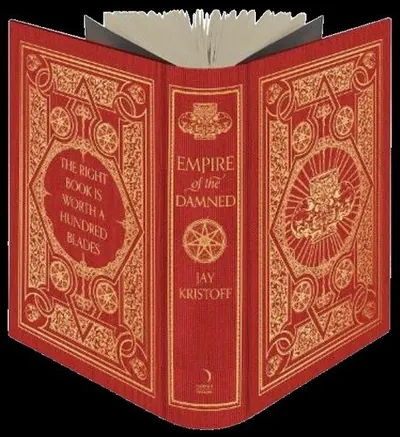
Empire of the Damned
Jay Kristoff
Author Reading Guide
Jay Kristoff is the Australian author of the Nevernight Chronicle, the Illuminae Files, and the Empire of the Vampire trilogy, which wrapped with Empire of the Dawn in late 2025.
Jay Kristoff
Jay Kristoff
Jay Kristoff is a Perth-born, Melbourne-based Australian who spent a decade in advertising before his 2012 debut Stormdancer opened the Lotus War trilogy. The real breakout came in 2015 with Illuminae, co-written with Amie Kaufman, a YA space thriller told entirely through hacked documents, chat logs, and surveillance transcripts. The Illuminae Files became a bestselling trilogy and a design object as much as a novel, and Kristoff and Kaufman doubled down with the Aurora Cycle. If you have seen a teenager reading a book sideways to follow text spiraling across the page, that was probably his fault. The Aurora Cycle ran three further books of found-family space squad chaos and cemented Kaufman and Kristoff as a reliable brand name unit in YA science fiction.
His solo signature, though, is grimdark with a smirk. The Nevernight Chronicle, published 2016 through 2018, follows Mia Corvere through a school for assassins on a world where the suns almost never set. It is adult fantasy wearing YA marketing leathers: graphic violence, explicit sex, and sarcastic footnotes that either delight you or make you want to throw the book. Godsgrave, the middle volume, pulls off one of the better mid-series escalations in modern fantasy, and the trilogy's ending plays for keeps.
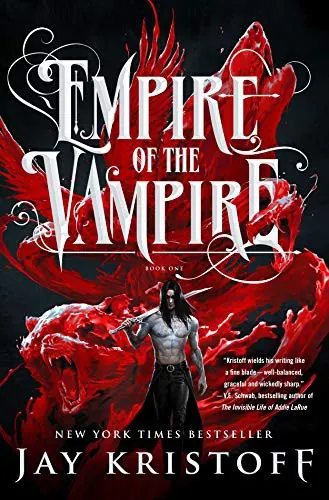
Empire of the Vampire, launched in 2021, is his biggest swing. Gabriel de León, last of the silversaint holy order, narrates his own legend from a cell to a vampire historian, twenty-seven years after the sun failed and the dead inherited Europe-in-all-but-name. Empire of the Damned followed in 2024, and the finale, Empire of the Dawn, arrived November 4, 2025 and went straight onto the New York Times list. The trilogy is now complete, which for fantasy readers scarred by open-ended series is practically a unique selling point. The vampire books are illustrated throughout, oversized, and heavy enough to stop a door, part of Kristoff's standing bet that print books should feel like objects worth owning.
What defines Kristoff is maximalism. Everything is turned up: the body counts, the blasphemy, the banter, the tragic backstories stacked three deep. The interview framing of Empire of the Vampire, a knowing nod to Anne Rice, lets him undercut and re-sell his own legend in the same chapter, and unreliable narration does a lot of load-bearing work. Fair criticism: the snark can puncture tension at exactly the wrong moment, his female characters skew toward the same lethal-and-gorgeous template, and subtlety is simply not on the menu. You know within thirty pages if he is your thing. Even his critics concede the man can write an action sequence, and his set pieces are storyboarded with a director's eye for escalation and collateral damage.
On our 0 to 5 spice scale, Nevernight and Empire of the Vampire both run a 2 to 3: the sex is explicit and reasonably frequent, but it shares the stage with a great deal of stabbing. These are not romance-structured books, the love stories end badly as often as not, and nobody should hand them to a reader expecting guaranteed HEAs. They work for the romantasy crowd as a palate cleanser with teeth: vampire courts, doomed devotion, and a body count your fae princes would not survive.
Where to start depends on appetite. Nevernight for assassins and footnotes, Illuminae for the YA sci-fi gateway, Empire of the Vampire if you want his best prose and a finished vampire epic you can binge start to end. Content warnings apply across the board: graphic violence, sexual content, torture, and harm to basically everyone you get attached to. He would consider that a blurb. For once, the marketing hyperbole and the reading experience roughly agree: bigger, louder, bloodier, and finished.