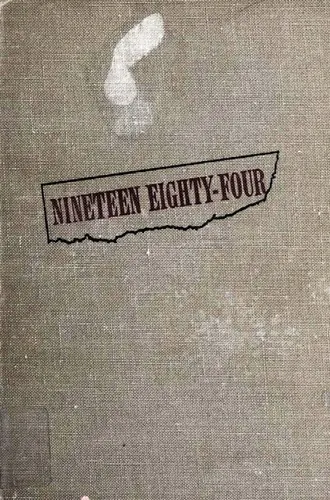
1984
George Orwell
Author Reading Guide
Author of 1984 and Animal Farm. Not remotely romantasy, but the dystopian bones under half the genre's rebellion plots are his.
George Orwell
George Orwell has no romance in his books unless you count Winston and Julia, and given how that ends, you should not. So what is he doing on a romantasy shelf? Two things. First, our database grew from a broader fantasy and speculative fiction collection, and some cornerstones earned their place before we narrowed the brand. Second, and more honestly: the rebellion plots that power half of modern romantasy, the masked courts, the surveillance states, the heroines lying to survive inside regimes that would execute them, all run on machinery Orwell built. Red Queen, Powerless, and every book where a heroine hides what she is from a watching state are running Orwell firmware with better kissing.
Eric Arthur Blair, born in 1903 in colonial India, took the pen name George Orwell in the 1930s while writing his way through poverty in Paris and London, imperial policing in Burma, and a bullet through the throat in the Spanish Civil War. That biography matters because everything he wrote came from watching power operate up close. He did not theorize about boots on faces; he had worn the boot and felt the face.
Animal Farm, published in 1945, compressed the betrayal of revolutionary ideals into a farmyard fable short enough to read in an evening and sharp enough to be banned across half the world. Nineteen Eighty-Four followed in 1949, written while Orwell was dying of tuberculosis on a Scottish island, and gave the next eighty years their vocabulary for authoritarianism: Big Brother, doublethink, thoughtcrime, the memory hole. Few novels have donated more words to everyday language, and none have donated darker ones.
He died in 1950 at forty-six, months after 1984 was published, which means he never saw the book become the permanent bestseller it remains. It resurges every time the news gets sufficiently alarming, which is to say constantly.
For our readers, the relevance is real even if the register is different. If you loved the surveilled-court paranoia of The Cruel Prince, the resistance cells of Red Queen, or the state-run trials of Powerless, Orwell is where those nerves come from, undiluted and with zero romantic consolation. Read 1984 once and every dystopian romantasy you pick up afterward becomes legible in a new way. Just do not expect anyone to hold hands in it. His books on our shelf are below.
The novels are only half the shelf. Orwell's nonfiction is where many readers end up living: Down and Out in Paris and London on poverty from the inside, Homage to Catalonia on watching a revolution eat itself in Spain, and the essays, which remain some of the best ever written in English. Politics and the English Language alone, his short manual on how dishonest language makes dishonest thought possible, explains more about propaganda than most full-length books manage, and Shooting an Elephant does the same for empire in a dozen pages. If 1984 hit you hard, the essays show you the working notes.
There is also a genuinely interesting recent addition to the shelf beside him: Julia, Sandra Newman's retelling of Nineteen Eighty-Four from Julia's point of view, authorized by the Orwell estate. It gives the novel's famously underwritten woman an interior life, a back story, and a survivor's cunning, and for readers of this site it is the natural companion piece, a heroine navigating a surveillance state written with modern instincts about whose story gets told. Read the original first, then Julia, and the pairing lands like a before-and-after photograph of how fiction treats women who resist. As entry points go, Animal Farm remains the right first step if you want the ideas in one sitting; it is barely a hundred pages and loses none of its teeth for being short.