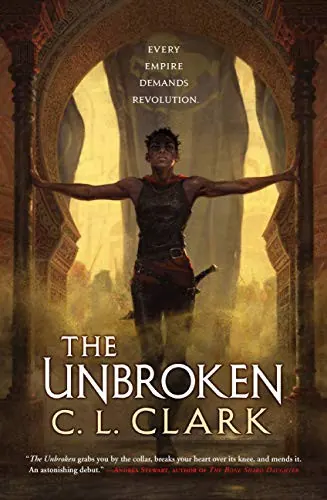
The Unbroken
C.L. Clark
Author Reading Guide
Author of the queer military fantasy trilogy Magic of the Lost, beginning with The Unbroken. An MFA graduate and Lambda Literary Fellow who writes politics with teeth.
C.L. Clark
C.L. Clark, full name Cherae Clark, is one of those authors whose biography reads like three different people. She holds an MFA in creative writing from Indiana University, was a 2012 Lambda Literary Fellow, has taught English, and works as a personal trainer. All of that shows up on the page: the prose discipline, the queer center of gravity, and fight scenes written by someone who understands what bodies can actually do.
Her debut, The Unbroken, landed in 2021 through Orbit and announced the Magic of the Lost trilogy. The setup is brutal and specific. Touraine is a soldier, stolen from her colonized homeland as a child and raised to fight for the empire that took her. Luca is the princess of that empire, trying to claw back her throne. The two of them collide in Qazal, a North African inspired colony on the edge of revolt, and every scene between them is a negotiation where desire and power refuse to stay in separate rooms. The Faithless followed in 2023, moving the action to the imperial court, and The Sovereign closed the trilogy in 2025, bringing Touraine and Luca together one last time. The whole story is now on shelves, which matters for a series this dependent on payoff.
Be clear about what you are getting: this is political and military fantasy first, romance second. The pull between Touraine and Luca is central and genuinely combustible, but Clark makes them earn every step through betrayals, bad decisions, and competing loyalties. It is enemies-to-lovers in the most literal sense, between a colonizer and the colonized, and the book never lets either of them off the hook. Readers who want their romance uncomplicated by politics will get frustrated. Readers who want the politics to BE the romance will lose their minds, in a good way.
On our spice scale The Unbroken rates a 3.5, and the heat is sapphic, charged, and inseparable from the power dynamics. This is not a book where intimacy resolves conflict. Usually it creates more.
Why does Clark matter to a romantasy audience? Because she represents the genre's sharpest edge. If your gateway was Fourth Wing and you find yourself wanting the military structure with heavier consequences, or you read She Who Became the Sun and wanted more longing in your empire-building, Magic of the Lost is the natural next step. It is also one of the defining sapphic fantasy romances of its era, on the shortlist with Priory for readers who ask where the women-loving-women epics are.
Clark's short fiction and editorial work round out the picture. Before and alongside the trilogy she published stories in respected speculative fiction venues and worked as an editor, and the craft shows in how tightly the novels are built. Nothing in these books is wasted. A throwaway line about a soldier's boots in book one becomes a gut punch two books later. She also writes exhaustion better than almost anyone in the genre. Touraine spends much of the trilogy physically and morally worn down, and Clark, who trains people's bodies for a living, renders that fatigue with a specificity most fantasy authors never attempt. The result is a trilogy that feels lived-in rather than staged, where war has weight, colonialism has mechanics rather than vibes, and love is something people choose again and again despite an empire's worth of reasons not to.
Start with The Unbroken and read the trilogy in order: The Unbroken, The Faithless, The Sovereign. There is no soft entry point, since each book builds directly on the wreckage of the last. Give the first one a hundred pages before you judge it. Clark drops you into the deep end with the politics, and the moment the book snaps into focus, you will understand why this trilogy has the reputation it does. Browse more like it on our morally gray leads shelf, though fair warning, Clark's women out-scheme most of the men on it.