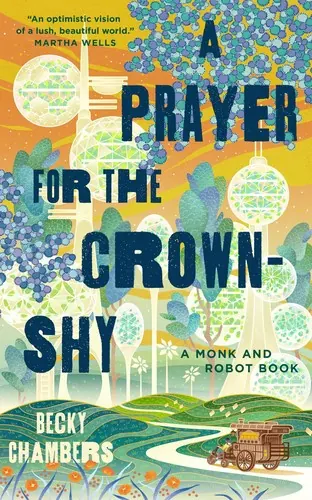
A Prayer for the Crown-Shy
Becky Chambers
Author Reading Guide
Hugo-winning author of the Wayfarers series and the Monk and Robot novellas, patron saint of cozy science fiction and tea served at the end of the world.
Becky Chambers

Becky Chambers
Becky Chambers more or less founded the genre that BookTok now calls cozy sci-fi, and she did it from outside the industry. Unable to sell her first novel the usual way, she funded it on Kickstarter, self-published The Long Way to a Small, Angry Planet in 2014, and watched word of mouth carry it to traditional publishers and eventually a Hugo Award for Best Series. The daughter of a space-industry family, an astrobiology enthusiast among them, she writes space with genuine affection for the science and none of the genre's usual appetite for war.
The Wayfarers books are the heart of her reputation: four standalone-ish novels about ordinary people in a busy galaxy, starting with the crew of the Wayfarer, a scruffy ship that bores wormholes for a living. Rosemary, running from her family name, joins a crew that includes the reptilian pilot Sissix, an engineer in love with the ship's AI, and the relentlessly cheerful tech Kizzy, and the plot is mostly the crew learning each other. The sequels wander to other corners: a rebooted AI learning to be a person, a human fleet that never reached a destination, four aliens stranded at a truck stop. The stakes are personal on purpose. Found family is not a subplot in Chambers, it is the entire load-bearing structure.
The Monk and Robot novellas distilled the approach to its essence and won her the Hugo for Best Novella. In A Psalm for the Wild-Built, from 2021, a nonbinary tea monk named Dex, whose job is literally serving tea and listening to people's troubles, meets Mosscap, a robot returned from the wilderness centuries after robots gained consciousness and walked away, asking one question: what do people need? A Prayer for the Crown-Shy followed in 2022, an omnibus edition arrived in May 2025, and a new book, As You Wake, Break the Shell, is scheduled for October 2026.
Fair criticism, freely given: sometimes nothing happens. Readers wired for plot can find whole chapters where the central event is a conversation and a hot beverage, and the relentless reasonableness of her characters can blur conflict into mild friction. This is all deliberate, her books are arguments that kindness is interesting, but you should know what you are ordering. Heat level is a 0 to 1, with queer and polyamorous relationships woven in matter-of-factly and no on-page spice.
For romantasy readers the overlap is bigger than it looks. The thing you chase through five hundred pages of fae court intrigue, that moment where the prickly found family closes ranks around the heroine, is the thing Chambers serves as the main course. She is the ideal recovery read after a series destroys you, the literary equivalent of Dex's tea service.
Between the two series she also published To Be Taught, If Fortunate, a standalone novella about four astronauts surveying exoplanets while decades pass on an Earth that may have stopped listening, and it is quietly her most melancholy and most science-forward work, the one to hand to hard sci-fi readers who think cozy means unserious. Her fingerprints are all over the current wave: the cozy fantasy boom of coffee shops and low stakes, Legends and Lattes and its many descendants, follows a trail she blazed in space first. She has said she writes the futures she can stand to live in, which lands differently with each passing news cycle, and it is why her books get prescribed between heavier reads like medication.
Where to start: A Psalm for the Wild-Built if you want to test the waters in two hours, it is the purest dose of what she does. The Long Way to a Small, Angry Planet if you want the full crew experience. Read her between darker books, or on a bad week. That is what she is for, and she would be the first to say so.