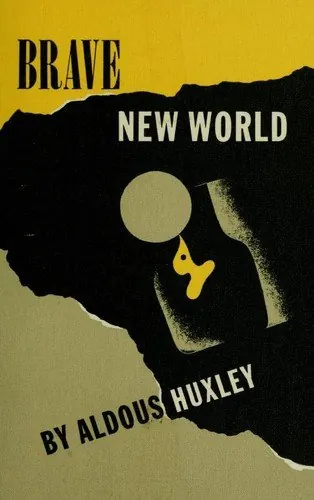
Brave New World
Aldous Huxley
Author Reading Guide
English novelist and essayist who wrote Brave New World (1932), the dystopia where comfort is the cage. He is on this shelf as genre ancestry: the anti-romance that accidentally makes the best case for longing.
Aldous Huxley
Aldous Huxley was born in 1894 in Godalming, Surrey, into what can only be described as Victorian intellectual royalty. His grandfather was Thomas Henry Huxley, the biologist so fierce in defending evolution that he was nicknamed Darwin's bulldog, and the family expectation was science. A serious eye disease at sixteen left him nearly blind for a stretch and ended any medical ambitions, which is how English literature acquired him instead. After Oxford he made his name in the 1920s with sharp society satires, Crome Yellow (1921) and Point Counter Point (1928) chief among them, the kind of books where clever people quietly destroy each other over dinner.
Then came Brave New World in 1932, the book that ate the rest of his reputation. It imagines a World State where humans are grown in hatcheries, sorted into castes before birth, and kept docile with a perfect drug called soma and a culture of guilt-free promiscuity. The phrase 'everyone belongs to everyone else' is state doctrine. Into this engineered paradise stumbles John, raised outside civilisation on a salvaged volume of Shakespeare, who looks at a world with no pain, no mothers, no marriage and no longing, and demands the right to be unhappy. Nearly a century later it remains one of the most quoted, most assigned, and most argued-about novels in the English language.
Huxley's second act was stranger than most fiction. He moved to California in 1937 and wrote Hollywood screenplays, including the 1940 Pride and Prejudice with Laurence Olivier and Greer Garson, which means the author of literature's great anti-romance has an actual romance movie credit. He drifted toward mysticism, took mescaline under supervision and wrote The Doors of Perception (1954) about the experience, the essay the band The Doors later named themselves after. His final novel, Island (1962), built the hopeful mirror image of Brave New World. He died on November 22, 1963, the same day as John F. Kennedy and C.S. Lewis, having asked his wife for LSD on his deathbed. She obliged.
So what is he doing on a romantasy shelf? Ancestry, and a surprisingly sharp lesson. Brave New World is a thought experiment in deleting everything romance runs on. Desire is satisfied instantly, so it never builds. Attachment is treated as illness. There is no waiting, no jealousy, no devotion, no single person who matters more than the rest. Reading it, you feel the absence like a missing tooth, and you understand exactly why the slow burn works: longing is not an obstacle to happiness, it is proof that something is worth wanting. Every arranged marriage plot and every fated-mates bond on this site is arguing against the World State, whether the author knows it or not.
Honesty requires admitting the book has flaws. The characters are chess pieces, the women get especially thin treatment, and the late chapters turn into a philosophy seminar in which the Resident World Controller explains the theme at generous length. Orwell gets more classroom time, but Huxley has aged better: he predicted we would be controlled not by the boot but by the entertainment we choose ourselves, which lands differently in the age of the infinite scroll. On heat: sex is everywhere in Brave New World and it is the least sexy sex ever committed to print, written with the warmth of a lab report. A 0 on our scale, and deliberately so. That is the entire point.
Where to start: Brave New World, obviously, and it is short enough to finish in two evenings. If it hooks you, The Doors of Perception is a fascinating sixty pages, Island shows the same mind building instead of demolishing, and Point Counter Point is waiting if you want the 1920s gossip. Then go read something where two people pine desperately across a ballroom, and notice how much sweeter it tastes.