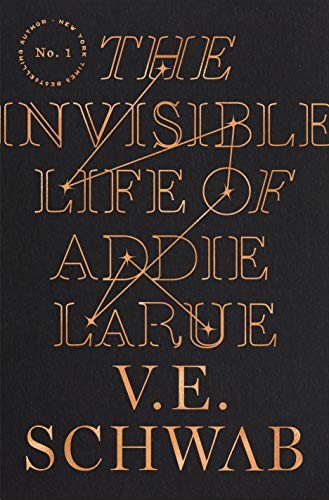
The Invisible Life of Addie LaRue
Addie LaRue makes a dark bargain to escape her fate, trading her identity to be forever forgotten by everyone she meets. For three hundred years she exists unseen, invisible to the world around her. One person remembers her, and everything changes.
Everything You Need to Know About The Invisible Life of Addie LaRue
In 1714, in a small village in France, a young woman named Adeline LaRue makes a desperate bargain with a god of darkness to escape an arranged marriage. She asks for freedom. She gets it, along with a curse. No one will ever remember her. The moment she leaves someone's presence, she is erased from their mind. She cannot write her name, cannot sign a lease, cannot leave a mark on anything. She is free, and she is invisible.
For three hundred years, Addie wanders through history. She walks through the French Revolution, two World Wars, the rise and fall of empires. She sleeps in doorways and stranger's beds. She cannot own anything, build anything, or keep anyone. The god who cursed her . Luc, who she calls the darkness, appears once a year to ask if she is ready to give up. She never does. Her stubbornness is the only thing she has left.
Then, in a bookshop in modern-day New York, a young man named Henry Strauss looks at her and says her name. He remembers. For the first time in three centuries, someone sees Addie LaRue. The question is why, and whether the answer is something she can survive.
Schwab structures this novel as a conversation between past and present, and the alternating timelines work beautifully. The historical sections are vivid without being exhaustive, you get the emotional texture of each era through Addie's experience rather than through period detail.
The premise is devastating in its specificity. Addie is not invisible , people see her, talk to her, sleep with her. They just cannot remember any of it. Schwab explores every implication: the loneliness, the small cruelties, and the unexpected freedoms. Addie cannot be imprisoned because no jailer remembers putting her there. She also cannot be loved.
Luc is a villain who defies easy categorisation. He is cruel, patient, and genuinely fascinated by Addie. Their annual meetings across centuries become a relationship of their own, adversarial, intimate, and addictive. He is the one constant in her life, which is exactly what makes him dangerous.
Henry's storyline provides the warmth the book needs. His own deal with darkness (which slowly comes into focus) mirrors Addie's, and their romance is tender precisely because both of them know, on some level, that it cannot last.
Themes of depression, hopelessness, and suicidal ideation (particularly Henry's backstory). A character makes a Faustian bargain under duress. Centuries of isolation and its psychological effects. A manipulative, controlling entity presented as a love interest (Luc). Brief violence. Sexual content (moderate). Themes of queer identity (Henry is bisexual). Discussion of what it means to live without being able to leave a legacy.
Henry's secret is the crux of the twist. He made his own deal with Luc, in exchange for people seeing him as their ideal, he gave up his soul. He has one year to live. When he meets Addie, her curse and his deal cancel each other out: she cannot be forgotten, and he cannot help but be drawn to her. Their love is real, but it was made possible by two separate acts of desperation.
Luc's game becomes clear in the final act. He let Henry remember Addie on purpose. It was not an accident or a loophole , it was Luc's latest move in his centuries-long attempt to break Addie's will. If she falls in love with someone who is going to die, the grief might finally make her surrender.
Addie outplays him. She convinces Luc to take her deal: Henry lives, Addie goes with Luc willingly. But the catch, and this is where the book earns its title, is that she has finally found a way to leave a mark. Henry, a writer who could never finish a book, writes Addie's story. Her invisible life becomes a novel. She is remembered.
The ending leaves Addie's fate deliberately open. She is with Luc but not defeated. The story she left behind exists in the world. Whether that is a happy ending depends entirely on what you believe matters more: freedom or legacy.
If you love character-driven, literary-leaning fantasy, The Night Circus, Piranesi, The Time Traveler's Wife , this book is for you. Schwab writes genre-defying fiction that appeals to both fantasy readers and people who do not usually read fantasy.
The high-concept premise makes it a strong recommendation for book clubs. There is plenty to discuss about identity, memory, legacy, and what it means to matter.
This may not work if you want fast pacing. The book is contemplative and deliberately paced, especially in the historical sections. Readers who need plot-driven structure may find the middle section slow. The ending is divisive, some find it perfect, others find it unsatisfying.
The Invisible Life of Addie LaRue is a standalone novel. It is not connected to Schwab's other series (Shades of Magic, Villains). No sequel is planned or expected.
Reader Reviews
No reader reviews yet. Be the first!