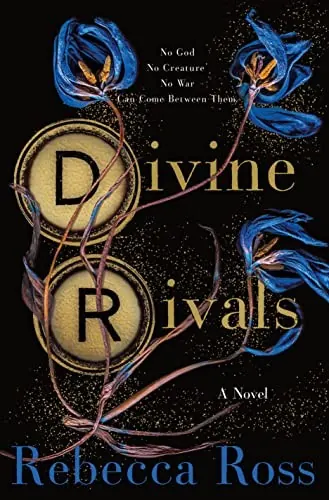
Divine Rivals
- Goodreads
- 4.3
- pages
- 512
- April
- 2024
Two rival journalists communicate through anonymous letters to a god, blending passion and politics in a world where divine intervention shapes human fate. As their connection deepens, they discover they're playing with forces beyond their control. What begins as competition becomes something far more dangerous.
What is Divine Rivals about?
Iris Winnow is a young journalist in the city of Oath, competing for a columnist position at the Oath Gazette against Roman Kitt, privileged, talented, and infuriatingly good at his job. They are rivals in every sense. They also happen to be anonymously writing letters to each other through a magical wardrobe, not knowing the person they are falling for on paper is the same person they are trying to beat in the office.
The setting is a world at war. Two gods are fighting through mortal proxies, and the conflict is consuming the countryside. When Iris's brother goes missing at the front lines, she volunteers as a war correspondent, leaving the city and the rivalry behind. Roman, for reasons he cannot fully explain even to himself, follows.
The war strips away everything comfortable. Iris and Roman must confront who they really are, to each other and to themselves, in a world of trenches, field hospitals, and divine wrath. The letters continue. The truth gets closer. And the war does not care about love stories.
Read it if you want
Ross writes romance the way it should feel in a war story, not as an escape from the horror but as the thing that makes the horror bearable. The letters between Iris and Roman are tender, honest, and increasingly desperate as the war closes in.
The rivals-to-lovers dynamic is perfectly structured. Their professional competition is genuine, both are talented, and the position matters to both. The shift to allies and then to something more happens through shared experience rather than forced proximity.
The war reporting angle gives the romance stakes that a peacetime setting could not. Iris writing about what she sees, the soldiers, the devastation, the small acts of courage, is some of the book's most powerful prose.
The mythology is elegant. Two gods at war, using mortals as pawns, with the letters serving as a connection between the divine and the human. Ross does not over-explain the magic system, she lets it breathe.
Content warnings
Show the content warnings
War violence including battlefield descriptions and civilian casualties. A character goes missing in combat. Field hospital scenes with injuries. Grief and loss. A parent's alcoholism affects the protagonist's childhood. Themes of propaganda and the human cost of divine conflicts. Moderate sexual content. A character faces the possibility of never seeing their loved one again.
Full plot and ending (spoilers)
Roman figures out early that his anonymous correspondent is Iris, and keeps writing anyway. Iris does not learn the truth until much later, at the front, and the reveal lands with all the anger and vulnerability the letters earned.
The gods' war is not metaphorical. Dacre and Enva are physically fighting through mortal armies, and Iris's reporting from towns like Avalon Bluff exposes what the papers back in Oath will not print.
Iris and Roman marry near the end, a small wartime wedding that makes the finale hurt worse. When Dacre's forces hit Avalon Bluff, Iris's brother Forest reappears, changed by the god who healed him, and drags her to safety while Roman is left behind, wounded and taken. The book ends with them separated, the marriage days old, and the war rolling on into Ruthless Vows.
Where it sits in the series
Divine Rivals is the first book in the Letters of Enchantment duology, followed by Ruthless Vows. The duology is complete. Can be read as a standalone entry point into Rebecca Ross's work.
Divine Rivals: FAQ
How spicy is Divine Rivals?
Divine Rivals is rated 2 out of 5 on our heat scale, which we call warm. The Spice Guide explains what each level means. Spice Guide
Is Divine Rivals a standalone?
As far as our catalogue shows, yes. Divine Rivals by Rebecca Ross is not part of a series, so you can start here.
What are the content warnings for Divine Rivals?
War violence including battlefield descriptions and civilian casualties. A character goes missing in combat. Field hospital scenes with injuries. Grief and loss. A parent's alcoholism affects the protagonist's childhood. Themes of propaganda and the human cost of divine conflicts.
How long is Divine Rivals?
Divine Rivals is 512 pages. At an average pace that is roughly 11 hours of reading.
When was Divine Rivals published?
Divine Rivals was first published on April 30, 2024.
Is Divine Rivals OK for teens?
It is better suited to older teens. At 2 out of 5 there is some on-page intimacy, written softly. Check the content warnings too.