The Weaver and the Witch Queen
Genevieve Gornichec
Author Reading Guide
Genevieve Gornichec writes Norse mythology and Viking-age historical fantasy with a scholar's accuracy and a novelist's cruelty, starting with her widely translated debut The Witch's Heart.
Genevieve Gornichec
Gornichec earned a history degree from Ohio State, where studying the Norse myths and the Icelandic sagas turned into the material for a career. Her debut, The Witch's Heart, arrived in 2021 and has since been translated into more than a dozen languages, which is unusual for a first novel and even more unusual for one this quiet. Her second, The Weaver and the Witch Queen, followed in 2023. She lives in northeast Ohio and has been known to spend weekends pretending to be a tenth-century Scandinavian weaver, which tells you roughly everything about the relationship between her research and her enjoyment of it.
What defines her writing is the choice to stay small inside enormous stories. The Witch's Heart takes Angrboda, the giantess who bore Loki's monstrous children, and gives her a life in a cave at the edge of the world: a marriage, a friendship with the huntress Skadi, three children she knows are prophesied to end everything. Ragnarok is coming the whole time, and the book is about the domestic decades before it. Gornichec writes grief and endurance rather than battle, and she trusts the reader to feel the weight of a myth's ending without staging it. Her prose is clean and unshowy. Her witch figures are practitioners rather than power fantasies, and their magic costs them.
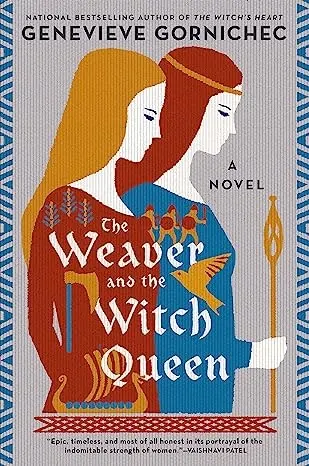
The Weaver and the Witch Queen moves from myth into history, following two women who meet as children in tenth-century Norway and grow into opposite lives. Oddny wants a quiet existence and ends up hunting for a stolen sister. Gunnhild wants power, escapes a cruel mother, and is on her way to becoming queen. Their bond is the actual love story of the novel, tested across years and incompatible ambitions, and Gornichec keeps the historical texture dense without letting it slow the book down. It is the more plot-driven of her two novels and the better starting point for readers who found the pace of the debut too still.
On heat, Gornichec is a 1 on the spice scale. There is desire in both books, there are relationships that matter enormously, and the intimate scenes are brief and mostly off the page. Anyone coming in for steam will leave unsatisfied. What is on offer instead is emotional intensity of a different order, the kind that comes from watching people love each other across decades in conditions that make it costly. Her romance is queer, complicated, and never the sole point of the story.
For a romantasy audience she is best framed as ancestry rather than as a direct match. The Norse-inflected corner of the genre, from Viking-flavoured fated mates to god-touched heroines, borrows heavily from this material, and Gornichec is where you go for the real thing done well. She is also the book to hand to someone who says they want something with the emotional weight of the genre but less of the heat, or who loved Circe and Kaikeyi and wants a third. Readers who like a slow burn measured in years rather than chapters will recognise what she is doing, even at a very different temperature.
Anyone who came to the genre through Norse-flavoured fated mates and then wondered what the actual sagas sound like will find the gap between the two instructive rather than disappointing. Gornichec is not writing a corrective to the popular version; she simply knows the material well enough that her inventions sit flush against the parts that are attested, and a reader cannot always tell where the seam is. That is the highest compliment available to historical fantasy.
Where to start: The Weaver and the Witch Queen if you want story, The Witch's Heart if you want to be wrecked. The two are unrelated and can be read in either order, with no shared characters or continuity. The Witch's Heart is the more emotionally punishing of the two and the one readers talk about years later, so if you only read one, read that, and give yourself an evening afterward with nothing scheduled.