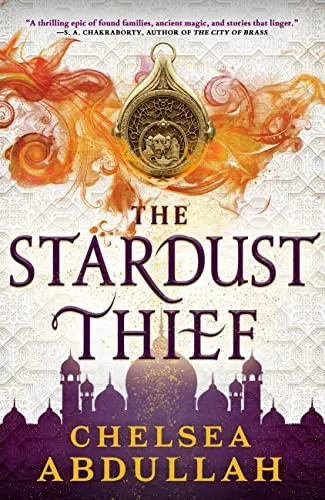
The Stardust Thief
Chelsea Abdullah
Author Reading Guide
Chelsea Abdullah is an American-Kuwaiti fantasy author whose Sandsea Trilogy rebuilds One Thousand and One Nights into a jinn-haunted adventure about the stories people tell to survive.
Chelsea Abdullah
Abdullah grew up in Kuwait listening to stories about desert creatures and unreliable heroes, took an MA in English at Duquesne University, and moved to New York, where she wrote a debut that landed with real force. The Stardust Thief published in 2022 as the opening of the Sandsea Trilogy, drawing directly on One Thousand and One Nights rather than treating it as decoration. The sequel, The Ashfire King, followed after a long wait, and a third volume, The Midnight Merchant, is set to close the trilogy.
What defines her writing is structure. Abdullah nests stories inside stories the way her source material does, letting a tale told around a fire turn out to be load-bearing for the plot two hundred pages later. Her characters are all lying about something, usually to themselves, and the book is patient about revealing which version of events is true. She writes desert travel with weight, magic with rules and prices, and jinn who are neither villains nor romantic partners but people with a several-thousand-year grievance. The prose is atmospheric without being purple, and the pacing is deliberate in the first third before it accelerates hard.
The Stardust Thief follows Loulie al-Nazari, a merchant who trades in illegal magic with a jinn bodyguard at her side, forced into a hunt for a relic by a sultan who knows exactly what she is. Travelling with her are Mazen, a sheltered prince who wanted an adventure and gets a considerably worse one, and Aisha, a hunter with no patience for either of them. The Ashfire King picks up with Mazen and Loulie stranded among the jinn and pushes the trilogy's central question harder: whether a war fought before any of the characters were born can be ended by people who inherited only one side's version of it. The cast is small enough to know well, and the found family formed under duress is the emotional core of both books.
On heat, Abdullah is a 0 to 1 on the spice scale. This is adult fantasy in scope and violence, not in content. There is attraction, there are relationships developing across the trilogy, and the romance is a subplot in a book that is fundamentally about story, guilt, and inheritance. Going in expecting a central love story will misread the book. Going in expecting an adventure fantasy with excellent character work will not.
For romantasy readers she is a deliberate widening of the shelf. A lot of the genre draws on Western European fae and Greek myth, and the folklore Abdullah is working from is both older and largely unexploited by the current wave. The result reads unfamiliar in the best way: the magical logic is different, the moral framework is different, and the shape of the ending is not the one you are trained to expect. She is also the right recommendation for readers who want the immersive world-building of a long fantasy series without committing to a ten-book epic, since the trilogy is planned as a trilogy. If you are unsure whether a low-heat adventure fantasy suits your current mood, the reader quiz will steer you.
Abdullah is also, quietly, one of the better prose writers working in commercial fantasy right now, and the trilogy has held up to rereading better than most of what published alongside it. The nesting structure means a second pass reveals setup you could not have seen the first time.
Where to start: The Stardust Thief, and give it a hundred pages before deciding, because the nested structure takes a while to show what it is doing. Read The Ashfire King directly after; it assumes complete recall of the first book and there is no recap. If you are waiting on the final volume, this is a trilogy worth starting now rather than one to save, since the second book resolves enough to be satisfying on its own terms.